Book guide and evaluation
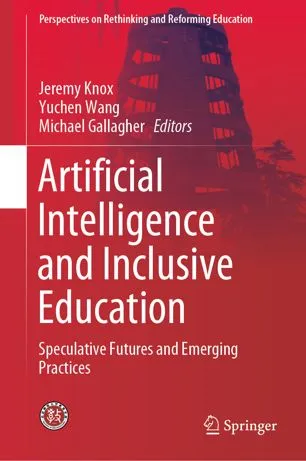
Artificial Intelligence and Inclusive Education: Speculative Futures and Emerging Practices
Jeremy Knox,Yuchen Wang,Michael Gallagher
English
Beginner
Artificial Intelligence (AI)
4.7 / 5
0 reviews
2019
Published
209
pages
409
views
This book brings together the fields of artificial intelligence (often known as A.I.) and inclusive education in order to speculate on the future of teaching and learning in increasingly diverse social, cultural, emotional, and linguistic educational contexts. This book addresses
Before you read
What will you get from this book?
This book brings together the fields of artificial intelligence (often known as A.I.) and inclusive education in order to speculate on the future of teaching and learning in increasingly diverse social, cultural, emotional, and linguistic educational contexts. This book addresses a pressing need to understand how future educational practices can promote equity and equality, while at the same time adopting A.I. systems that are oriented towards automation, standardisation and efficiency. The contributions in this edited volume appeal to scholars and students with an interest in forming a critical understanding of the development of A.I. for education, as well as an interest in how the processes of inclusive education might be shaped by future technologies. Grounded in theoretical engagement, establishing key challenges for future practice, and outlining the latest research, this book offers a comprehensive overview of the complex issues arising from the convergence of A.I. technologies and the necessity of developing inclusive teaching and learning.To date, there has been little in the way of direct association between research and practice in these domains: A.I. has been a predominantly technical field of research and development, and while intelligent computer systems and ‘smart’ software are being increasingly applied in many areas of industry, economics, social life, and education itself, a specific engagement with the agenda of inclusion appears lacking. Although such technology offers exciting possibilities for education, including software that is designed to ‘personalise’ learning or adapt to learner behaviours, these developments are accompanied by growing concerns about the in-built biases involved in machine learning techniques driven by ‘big data’.
Ask this book
Your question is answered in the context of this title and author. Each answer uses 2 points.
Sign in to ask the book assistant.
Reader reviews
0 reviews, 4.7 average out of 5
No reviews yet
If you have read this book, help the next reader with your experience.
Write a review
Sign in to publish a review.
Reader questions and answers
Ask a focused question and learn from the community.
Sign in to ask or answer a question.
No questions yet
Be the first to ask a clear, useful question.
What to read next
Related references that continue this learning path.
Feature Engineering for Machine Learning: Principles and Techniques for Data Scientists
Alice Zheng,Amanda Casari
2018
View book