Book guide and evaluation
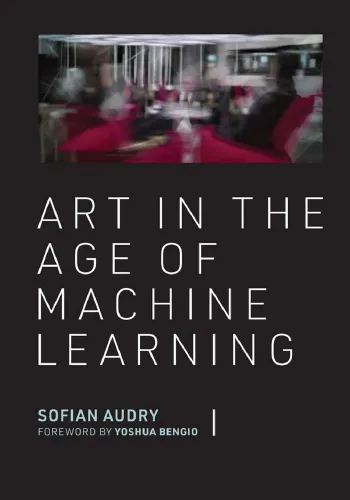
Art in the Age of Machine Learning (Leonardo)
Sofian Audry
English
Unordered
Machine Learning
4.2 / 5
0 reviews
2021
Published
214
pages
100
views
An examination of machine learning art and its practice in new media art and music. Over the past decade, an artistic movement has emerged that draws on machine learning as both inspiration and medium. In this book, transdisciplinary artist-researcher Sofian Audry examines artist
Before you read
What will you get from this book?
An examination of machine learning art and its practice in new media art and music. Over the past decade, an artistic movement has emerged that draws on machine learning as both inspiration and medium. In this book, transdisciplinary artist-researcher Sofian Audry examines artistic practices at the intersection of machine learning and new media art, providing conceptual tools and historical perspectives for new media artists, musicians, composers, writers, curators, and theorists. Audry looks at works from a broad range of practices, including new media installation, robotic art, visual art, electronic music and sound, and electronic literature, connecting machine learning art to such earlier artistic practices as cybernetics art, artificial life art, and evolutionary art. Machine learning underlies computational systems that are biologically inspired, statistically driven, agent-based networked entities that program themselves. Audry explains the fundamental design of machine learning algorithmic structures in terms accessible to the nonspecialist while framing these technologies within larger historical and conceptual spaces. Audry debunks myths about machine learning art, including the ideas that machine learning can create art without artists and that machine learning will soon bring about superhuman intelligence and creativity. Audry considers learning procedures, describing how artists hijack the training process by playing with evaluative functions; discusses trainable machines and models, explaining how different types of machine learning systems enable different kinds of artistic practices; and reviews the role of data in machine learning art, showing how artists use data as a raw material to steer learning systems and arguing that machine learning allows for novel forms of algorithmic remixes.
Ask this book
Your question is answered in the context of this title and author. Each answer uses 2 points.
Sign in to ask the book assistant.
Reader reviews
0 reviews, 4.2 average out of 5
No reviews yet
If you have read this book, help the next reader with your experience.
Write a review
Sign in to publish a review.
Reader questions and answers
Ask a focused question and learn from the community.
Sign in to ask or answer a question.
No questions yet
Be the first to ask a clear, useful question.
What to read next
Related references that continue this learning path.
Solutions Architect's Handbook: Kick-start your career as a solutions architect by learning architecture design principles and strategies, 2nd Edition
Saurabh Shrivastava,Neelanjali Srivastav
2022
View book
Solutions Architect's Handbook - Third Edition: Kick-start your career with architecture design principles, strategies, and generative AI techniques
Saurabh Shrivastava,Neelanjali Srivastav
2024
View book