Book guide and evaluation
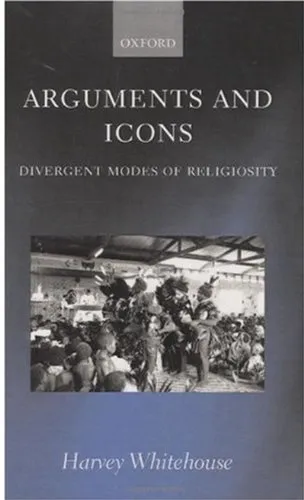
Arguments and Icons: Divergent Modes of Religiosity
Harvey Whitehouse
English
Intermediate
novel
4.5 / 5
0 reviews
2000
Published
110
pages
583
views
Introduction to 'Arguments and Icons: Divergent Modes of Religiosity' Authored by Harvey Whitehouse, 'Arguments and Icons: Divergent Modes of Religiosity' provides a compelling exploration into the cognitive and social dimensions of religious experience. This book examines how
Before you read
What will you get from this book?
Introduction to 'Arguments and Icons: Divergent Modes of Religiosity'
Authored by Harvey Whitehouse, 'Arguments and Icons: Divergent Modes of Religiosity' provides a compelling exploration into the cognitive and social dimensions of religious experience. This book examines how distinct modes of religiosity - imagistic and doctrinal - shape beliefs, practices, and social organization.
Detailed Summary of the Book
The central thesis of 'Arguments and Icons: Divergent Modes of Religiosity' revolves around two contrasting modes of religiosity: the doctrinal mode, which is characterized by frequent and routine religious teachings, and the imagistic mode, characterized by rare, intense, and often traumatic rituals. By analyzing a wide range of ethnographic and historical data, Harvey Whitehouse demonstrates how these diverging modes impact the nature of religious communities, their longevity, and the way they integrate with broader socio-political structures.
Whitehouse argues that the doctrinal mode facilitates the formation of large-scale religious communities. These communities are typically united by shared beliefs encoded through frequent rituals and teachings that are easy to transmit across generations. In contrast, the imagistic mode tends to produce smaller, more intimate groups where shared experiences and symbols forge strong emotional bonds among members, despite being less transmissible in terms of uniform beliefs.
This dichotomy helps explain a variety of religious phenomena, from the propagation of world religions to the formation of sects and cults. Through this framework, Whitehouse reinterprets historical events and cultural practices, offering fresh insights into the evolution of human religiosity.
Key Takeaways
- The doctrinal mode is characterized by frequent rituals and teachings that foster long-lasting, large-scale religious traditions.
- The imagistic mode creates deeply personal and emotionally charged religious experiences, often within smaller, tight-knit communities.
- Understanding these modes provides a valuable framework for analyzing religious dynamism and stability across different cultures and historical periods.
Famous Quotes from the Book
"Religious traditions are constructed and maintained through the interplay of doctrinal teachings and imagistic experiences."
"The distinction between doctrinal and imagistic modes influences not just beliefs and practices but the organizational structure and societal impact of religious communities."
Why This Book Matters
'Arguments and Icons: Divergent Modes of Religiosity' offers crucial insights into the cognitive and social underpinnings of religion, a defining feature of human societies. By dissecting how different modes of religiosity function and interact, Harvey Whitehouse provides a framework that not only enhances our understanding of religion but also sheds light on broader human behaviors and institutions. This book is particularly relevant to anthropologists, sociologists, historians, and those interested in the interplay between culture and cognition. Its implications extend beyond academia, offering practical insights into contemporary religious dynamics and intercultural understanding.
Ask this book
Your question is answered in the context of this title and author. Each answer uses 2 points.
Sign in to ask the book assistant.
Reader reviews
0 reviews, 4.5 average out of 5
No reviews yet
If you have read this book, help the next reader with your experience.
Write a review
Sign in to publish a review.
Reader questions and answers
Ask a focused question and learn from the community.
Sign in to ask or answer a question.
No questions yet
Be the first to ask a clear, useful question.
What to read next
Related references that continue this learning path.