


Book guide and evaluation
Applied Partial Differential Equations. Visual Approach
Peter Markowich
English
Beginner
Mathematics
4.3 / 5
0 reviews
2006
Published
210
pages
177
views
Introduction to "Applied Partial Differential Equations: A Visual Approach" Welcome to an immersive journey through the fascinating world of partial differential equations (PDEs). "Applied Partial Differential Equations: A Visual Approach" is a comprehensive resource aimed at
Before you read
What will you get from this book?
Introduction to "Applied Partial Differential Equations: A Visual Approach"
Welcome to an immersive journey through the fascinating world of partial differential equations (PDEs). "Applied Partial Differential Equations: A Visual Approach" is a comprehensive resource aimed at bringing clarity, intuition, and practical understanding to one of mathematics' most dynamic fields. This book is designed for readers at all levels, whether you are a student striving to grasp fundamental concepts, a researcher exploring new methodologies, or an engineer seeking practical tools for problem-solving.
Presented with a strong visual emphasis, the book integrates graphical insights to demystify complex ideas. Packed with theoretical foundations, real-world applications, and numerical solutions, this work bridges the gap between abstraction and practice, offering a rich, hands-on learning experience. Let’s delve into its key components, understand why this resource matters, and extract inspiring takeaways from its pages.
Detailed Summary of the Book
The book comprises a carefully structured exploration of partial differential equations, starting with the basics and advancing to sophisticated methods and applications. Its goal is not just to teach PDEs but to provide readers with an experiential understanding of their role in modeling real-life phenomena, such as fluid dynamics, heat transfer, wave propagation, and more.
Key themes covered in the book include:
- A thorough introduction to PDE classifications like elliptic, parabolic, and hyperbolic equations.
- Analytical solutions of classical PDEs, including separation of variables and Fourier series.
- An emphasis on visual interpretation through plots, diagrams, and numerical simulations.
- Modern approaches, such as finite element and finite difference methods, for solving PDEs computationally.
- Applications in physics, engineering, biology, and finance to highlight multidisciplinary uses.
Throughout the book, complex theories are made accessible, and concepts are broken into manageable explanations. By grounding mathematics in real-world scenarios, this resource transforms PDEs from abstract ideas to essential tools for inquiry and innovation.
Key Takeaways
Readers of "Applied Partial Differential Equations: A Visual Approach" will leave with a well-rounded understanding of both the theoretical and practical aspects of PDEs. Here are the key takeaways from the book:
- A solid foundation in the mathematical principles behind PDE classification and analytical solutions.
- Enhanced ability to visualize abstract concepts through graphs and visual aids.
- Exposure to cutting-edge numerical methods and computational techniques to solve modern-day challenges.
- An appreciation of the interdisciplinary applications of PDEs, from quantum physics to biomedical engineering.
- A deep understanding of the interplay between theory, computation, and real-world modeling.
Whether you are new to the field or refining your expertise, these takeaways empower you to tackle complex problems confidently and creatively using PDEs.
Famous Quotes from the Book
PDEs are as much about their beauty and elegance as they are about their practicality. Here are a few inspiring excerpts from the book:
"The language of partial differential equations is the bridge between the mathematics of abstraction and the physics of reality."
"A good visualization is more than just a drawing — it is a gateway to understanding otherwise inaccessible realms of mathematical thought."
"Every elegantly solved PDE tells a story — of balance, transformation, and the universal laws shaping our world."
These quotes capture the ethos of the book: making the abstract concrete and the complex comprehensible.
Why This Book Matters
Partial differential equations remain a cornerstone of mathematical modeling in science and engineering. Yet, their inherent complexity often deters learners. This book addresses that challenge head-on by introducing a visual and applied approach that brings PDEs within everyone’s reach.
Here’s why this book is indispensable:
- It prioritizes accessibility without compromising on rigor, making it ideal for learners at various stages.
- Its visual approach fosters intuition, enabling readers to ‘see’ rather than merely calculate solutions.
- The inclusion of real-world examples prepares readers to apply their knowledge in diverse fields.
- Cutting-edge numerical methods give readers a competitive edge in computational problem-solving.
- Its interdisciplinary focus situates PDEs within the larger context of contemporary science and technology.
Ultimately, this book bridges the gap between theoretical rigor and practical relevance. It serves as both a foundational text and a lifelong reference for anyone who aims to engage with PDEs thoughtfully and effectively.
Ask this book
Your question is answered in the context of this title and author. Each answer uses 2 points.
Sign in to ask the book assistant.
Reader reviews
0 reviews, 4.3 average out of 5
No reviews yet
If you have read this book, help the next reader with your experience.
Write a review
Sign in to publish a review.
Reader questions and answers
Ask a focused question and learn from the community.
Sign in to ask or answer a question.
No questions yet
Be the first to ask a clear, useful question.
What to read next
Related references that continue this learning path.


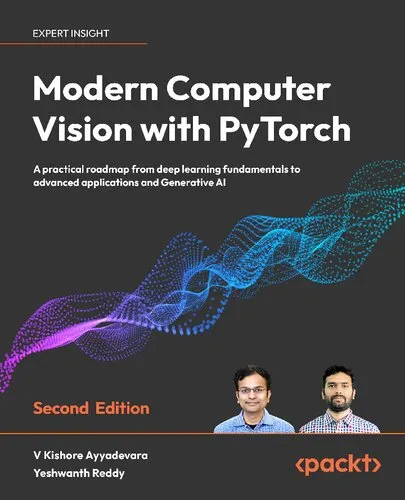
Modern Computer Vision with PyTorch: A Practical Roadmap From Deep Learning Fundamentals to Advanced Applications and Generative AI, 2nd Edition
V Kishore Ayyadevara,Yeshwanth Reddy
2023
View book