

Book guide and evaluation
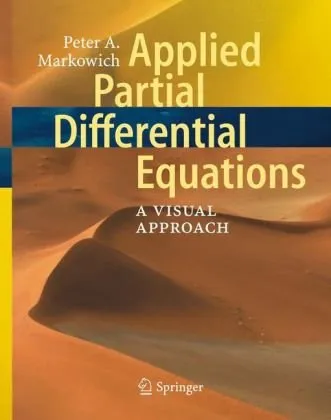
Applied Partial Differential Equations. A Visual Approach
Peter Markowich
English
Beginner
Mathematics
4.3 / 5
0 reviews
2007
Published
210
pages
191
views
Introduction "Applied Partial Differential Equations. A Visual Approach" is an innovative and comprehensive resource crafted for students, professionals, and enthusiasts aiming to dive deep into the realm of partial differential equations (PDEs). Written with an en
Before you read
What will you get from this book?
Introduction
"Applied Partial Differential Equations. A Visual Approach" is an innovative and comprehensive resource crafted for students, professionals, and enthusiasts aiming to dive deep into the realm of partial differential equations (PDEs). Written with an engaging blend of mathematical rigor and intuitive understanding, this book weaves theoretical concepts with practical applications, making it accessible to both novices and experienced mathematicians alike. What sets this book apart is its unique visual approach — offering clarity to complex problems through graphs, diagrams, and illustrative examples.
The book is designed to strike a balance between mathematical theory and real-world applications, ensuring that readers gain not only intellectual proficiency but also practical problem-solving skills. Whether you are interested in physics, engineering, economics, biology, or any other field where PDEs are pivotal, "Applied Partial Differential Equations. A Visual Approach" equips you with the tools and insights needed to navigate and solve these intricate equations. By reframing traditional learning methods through the lens of visualization, the book fosters a deeper connection between abstract equations and their tangible significances.
Detailed Summary
This book takes readers on a journey through the world of Partial Differential Equations, starting from the foundational concepts and advancing towards more intricate and specialized areas. By employing a step-by-step methodology, the text ensures that concepts build upon each other, fostering a logical understanding of the subject.
Early chapters focus on the essentials: definitions, formation, and classification of partial differential equations. Core topics such as boundary conditions and fundamental solutions are discussed extensively. From there, the text progresses into the Laplace equation, heat equation, and wave equation, which form the cornerstone of classical PDE theory. Building on these foundations, subsequent chapters delve into Fourier analysis, finite difference methods, and the numerical approaches needed for solving modern, real-world problems.
Throughout the book, the visual approach takes precedence. Graphical solutions, carefully designed diagrams, and illustrative plots guide readers through concepts that are often challenging to comprehend. Moreover, practical examples related to physics, biology, and engineering ensure that abstract mathematical theories are grounded in reality.
Importantly, the book is structured to cater to a wide range of audiences. While advanced sections challenge seasoned readers, introductory chapters remain user-friendly for those new to PDEs. Clear annotations and explanations ensure that no one feels left behind, regardless of their mathematical background.
Key Takeaways
By reading "Applied Partial Differential Equations. A Visual Approach," readers will:
- Understand the theoretical underpinnings of partial differential equations.
- Gain practical skills in applying PDE models to real-world problems.
- Utilize visual tools and graphical representations for solving complex equations.
- Bridge the gap between mathematics and practical scientific applications.
- Master essential topics like the Laplace equation, heat equation, and wave equation.
Famous Quotes from the Book
"Partial differential equations are not just mathematical constructs; they are the language through which the universe speaks."
"Visualization is the bridge that connects abstract equations to the tangible world."
"To solve a partial differential equation is to bring order to chaos, a journey from uncertainty to understanding."
Why This Book Matters
Amid the plethora of resources on partial differential equations, "Applied Partial Differential Equations. A Visual Approach" stands out for its dedication to making the subject accessible, engaging, and practical. This book matters because it transforms a traditionally challenging topic into an opportunity for discovery and mastery, by leveraging the power of visualization.
In today’s interconnected world, where PDEs are at the heart of groundbreaking discoveries in physics, engineering, medical science, and beyond, mastering these equations has never been more relevant. This book not only equips readers to tackle such challenges but also inspires a passion for the interplay between mathematics and the real world. Moreover, its structured visual approach bridges academic theory and practical implementation, ensuring its relevancy across multiple disciplines.
Whether you are an undergraduate student, a seasoned researcher, or a professional seeking to refine your skills, "Applied Partial Differential Equations. A Visual Approach" offers an unparalleled journey into the core of applied mathematics, making it an indispensable addition to your library.
Ask this book
Your question is answered in the context of this title and author. Each answer uses 2 points.
Sign in to ask the book assistant.
Reader reviews
0 reviews, 4.3 average out of 5
No reviews yet
If you have read this book, help the next reader with your experience.
Write a review
Sign in to publish a review.
Reader questions and answers
Ask a focused question and learn from the community.
Sign in to ask or answer a question.
No questions yet
Be the first to ask a clear, useful question.
What to read next
Related references that continue this learning path.


Modern Computer Vision with PyTorch: A Practical Roadmap From Deep Learning Fundamentals to Advanced Applications and Generative AI, 2nd Edition
V Kishore Ayyadevara,Yeshwanth Reddy
2023
View book