
Book guide and evaluation
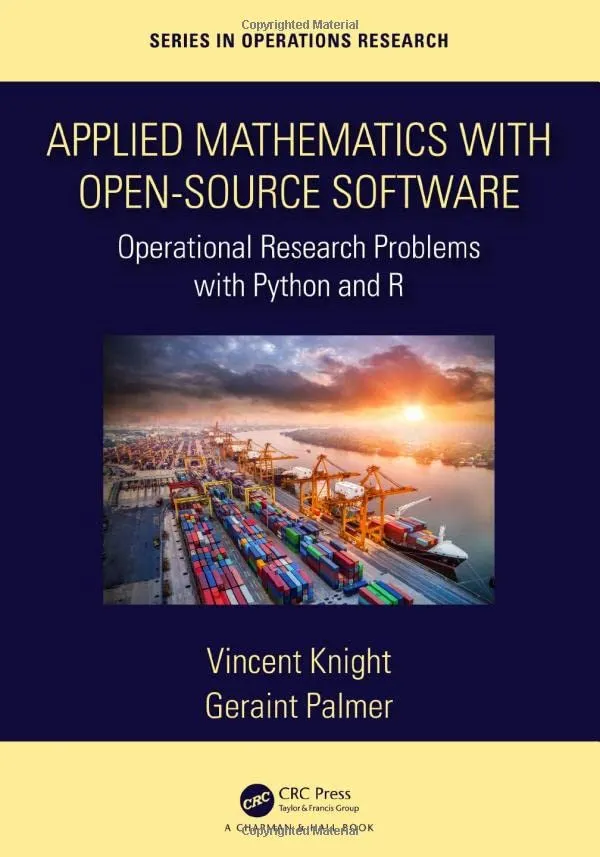
Applied Mathematics with Open-Source Software: Operational Research Problems with Python and R
Vincent Knight,Geraint Palmer
English
Beginner
Mathematics
4.6 / 5
0 reviews
2022
Published
153
pages
183
views
Introduction to "Applied Mathematics with Open-Source Software: Operational Research Problems with Python and R" In the modern landscape of data-driven decision-making, operational research (OR) serves as a cornerstone for businesses, governments, and non-profits looking t
Before you read
What will you get from this book?
Introduction to "Applied Mathematics with Open-Source Software: Operational Research Problems with Python and R"
In the modern landscape of data-driven decision-making, operational research (OR) serves as a cornerstone for businesses, governments, and non-profits looking to optimize their processes and solve complex problems. "Applied Mathematics with Open-Source Software: Operational Research Problems with Python and R" is designed to bridge the gap between advanced mathematical theory and practical computational implementation. By leveraging powerful open-source tools such as Python and R, this book equips readers with the skills and knowledge necessary to tackle real-world OR challenges in an accessible and efficient manner.
Our aim with this book is twofold: first, to demonstrate the power of open-source software in solving operational research problems; and second, to provide readers with a solid foundation in applied mathematics and computation. Whether you're an academic, a student, or a professional working in industries like logistics, healthcare, or finance, this book is equipped to guide you through the fascinating world of operational research with practical and reproducible solutions.
Detailed Summary of the Book
The book is structured to take readers on a progressive journey into the field of operational research, emphasizing problem-solving with Python and R programming languages. Each chapter focuses on a classic OR problem, presenting a blend of mathematical formulation, coding techniques, and application-driven problem-solving strategies. Moreover, the book emphasizes reproducible research, ensuring that readers not only learn to solve problems but also document and share their solutions effectively.
We begin with an introduction to the building blocks of operational research: optimization, simulation, and queuing theory. These foundational concepts are accompanied by hands-on implementations using Python and R. Moving forward, we delve into real-world applications, such as supply chain optimization, resource allocation, simulation modeling, and decision analysis. Each application-centric chapter starts with an explanation of the mathematical models underlying the problem before demonstrating their computational solutions.
A unique aspect of this book is its emphasis on open-source software. Python libraries such as NumPy, SciPy, and PuLP are extensively used, while R packages like dplyr, ggplot2, and ompr complement the Python-centric chapters. This dual-language approach ensures that readers gain exposure to different programming paradigms while also understanding the comparative strengths of each tool. By the end of the book, readers will have a portfolio of skills and practical examples that can be immediately applied to research or industry needs.
Key Takeaways
- Comprehensive understanding of core operational research concepts, including linear programming, integer programming, and Monte Carlo simulation.
- Hands-on tutorials demonstrating the application of Python and R for solving OR problems.
- Emphasis on reproducible research to ensure transparency and replicability of computational results.
- Practical insights into applying OR techniques to real-world scenarios in logistics, healthcare, and resource planning.
- A balanced dual-language approach, enabling proficiency in both Python and R for OR applications.
Famous Quotes from the Book
"Operational research is not just about solving theoretical puzzles; it is about addressing the core challenges of efficiency, resource allocation, and optimization that impact our daily lives."
"The true power of open-source software lies in its ability to democratize knowledge. With Python and R, anyone with an internet connection can harness state-of-the-art tools and methodologies."
Why This Book Matters
In an era where data is the driving force behind decisions, the ability to model, simulate, and optimize is more critical than ever. Operational research lies at the heart of this paradigm, offering systematic approaches to complex problems. However, traditional OR methods are often locked behind expensive software licenses, limiting access to this transformative field. This book aims to change that by demonstrating how free, open-source tools can rival, and in many cases surpass, proprietary alternatives.
Additionally, this book is tailored for accessibility. By combining rigorous theoretical exploration with practical coding exercises, it speaks to a diverse range of readers—from students new to OR to experienced professionals seeking modern computational insights. Its dual-language approach ensures that no matter your familiarity with programming, you can glean actionable insights and transferable skills.
Perhaps most importantly, "Applied Mathematics with Open-Source Software: Operational Research Problems with Python and R" embodies the philosophy of reproducible, open science. In an age where transparency and accountability are paramount, the tools and methodologies detailed in the book provide readers with the means to create, document, and share research that stands up to scrutiny and inspires further innovation.
In summary, whether you're looking to optimize a supply chain, model healthcare systems, or simply explore the versatile world of Python and R, this book is an indispensable resource for turning complex mathematical concepts into practical, actionable solutions.
Ask this book
Your question is answered in the context of this title and author. Each answer uses 2 points.
Sign in to ask the book assistant.
Reader reviews
0 reviews, 4.6 average out of 5
No reviews yet
If you have read this book, help the next reader with your experience.
Write a review
Sign in to publish a review.
Reader questions and answers
Ask a focused question and learn from the community.
Sign in to ask or answer a question.
No questions yet
Be the first to ask a clear, useful question.
What to read next
Related references that continue this learning path.
Modern Computer Vision with PyTorch: A Practical Roadmap From Deep Learning Fundamentals to Advanced Applications and Generative AI, 2nd Edition
V Kishore Ayyadevara,Yeshwanth Reddy
2023
View book