

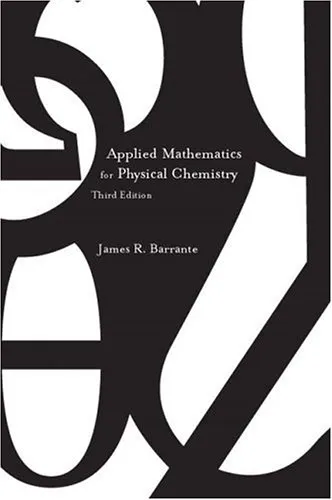
Book guide and evaluation
Applied Mathematics for Physical Chemistry
James R. Barrante
English
Beginner
Mathematics
4.3 / 5
0 reviews
2003
Published
117
pages
280
views
Introduction to "Applied Mathematics for Physical Chemistry" Mathematics serves as the cornerstone of physical chemistry, bridging the gap between theoretical science and applied experimentation. "Applied Mathematics for Physical Chemistry" by James R. Barrante is a compre
Before you read
What will you get from this book?
Introduction to "Applied Mathematics for Physical Chemistry"
Mathematics serves as the cornerstone of physical chemistry, bridging the gap between theoretical science and applied experimentation. "Applied Mathematics for Physical Chemistry" by James R. Barrante is a comprehensive guide tailored for students, professionals, and educators who seek an intuitive yet rigorous approach to mastering the mathematical principles underpinning physical chemistry.
This book aims to demystify the complexities of mathematical applications in physical chemistry by breaking topics into digestible, logical segments. Whether you're grappling with thermodynamics, quantum mechanics, or kinetics, this book provides the tools and insights necessary to excel in academics or industrial research. Below, we delve into an analytical overview of its main attributes and lasting significance.
Detailed Summary
"Applied Mathematics for Physical Chemistry" is more than a traditional textbook—it serves as an indispensable guide for understanding the interplay between math and chemistry. The book focuses on practical applications of mathematical concepts such as calculus, differential equations, linear algebra, and statistics, while linking them directly to chemical phenomena. With real-world examples and thoughtfully designed explanations, the material sets the stage for learning how to mathematically model and solve chemical problems.
The author begins by revisiting foundational topics, ensuring that even those with limited mathematical background can follow along. Complex subjects like partial differentiation, error analysis, and Fourier transforms are explained in a highly accessible manner, yet retain the depth needed for advanced learners.
The book is structured to accompany students through their journey in physical chemistry, balancing theory with practical applications. Whether you're solving a Schrödinger equation for a quantum mechanical system, analyzing the kinetics of a reaction, or exploring thermodynamic properties, Barrante's logical framework makes these calculations approachable and relevant.
Key Takeaways
- A step-by-step guide to understanding mathematical tools like matrices, differential equations, and vector algebra in the context of chemistry.
- Applications of integral calculus in calculating thermodynamic properties such as entropy and enthalpy.
- A simple yet thorough presentation of quantum mechanical principles using mathematical techniques.
- Practical examples that link chemical theory with industrial applications and experimental data analysis.
- Comprehensive coverage of statistical approaches, including probability distributions and curve fitting, crucial for interpreting experimental results.
Famous Quotes from the Book
"Mathematics is not a separate entity from chemistry; it is the lens through which the beauty and logic of the physical world are understood."
"The key to mastering physical chemistry lies in understanding the language of mathematics, not merely memorizing equations."
Why This Book Matters
The relevance of "Applied Mathematics for Physical Chemistry" extends far beyond classrooms. In a discipline as intricate as physical chemistry, the ability to effectively apply mathematical techniques is not just a skill—it's a necessity. The book's precise and application-driven approach equips readers with the tools required for solving real-world problems in academia, industry, and research environments.
Moreover, Barrante approaches topics with an educator's clarity, carefully addressing common misconceptions and providing intuitive explanations. This makes the book incredibly valuable not only for students but also for faculty members designing curriculums and researchers looking to touch up on quantitative skills.
The true significance of the book lies in its ability to inspire confidence in its readers. By presenting mathematical principles in the context of chemical challenges, it fosters a deeper appreciation of both disciplines and prepares individuals to tackle sophisticated problems in their professional journeys.
In conclusion, "Applied Mathematics for Physical Chemistry" is not just a textbook; it is a well-crafted roadmap guiding students and professionals towards mastering one of the most challenging yet rewarding aspects of the chemical sciences. Its relevance, depth, and clarity ensure that it remains a staple resource for anyone involved in the study or application of physical chemistry.
Ask this book
Your question is answered in the context of this title and author. Each answer uses 2 points.
Sign in to ask the book assistant.
Reader reviews
0 reviews, 4.3 average out of 5
No reviews yet
If you have read this book, help the next reader with your experience.
Write a review
Sign in to publish a review.
Reader questions and answers
Ask a focused question and learn from the community.
Sign in to ask or answer a question.
No questions yet
Be the first to ask a clear, useful question.
What to read next
Related references that continue this learning path.



Modern Computer Vision with PyTorch: A Practical Roadmap From Deep Learning Fundamentals to Advanced Applications and Generative AI, 2nd Edition
V Kishore Ayyadevara,Yeshwanth Reddy
2023
View book