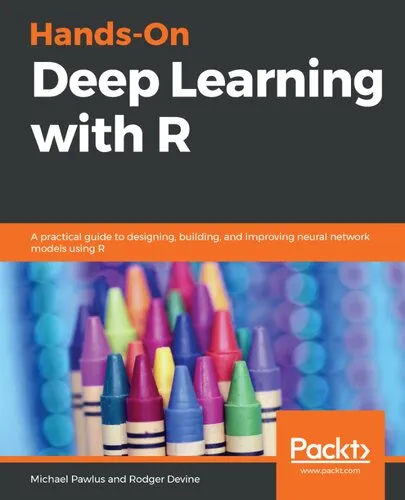
Hands-On Deep Learning with R: A practical guide to designing, building, and improving neural network models using R
Michael Pawlus,Rodger Devine
2020
View book
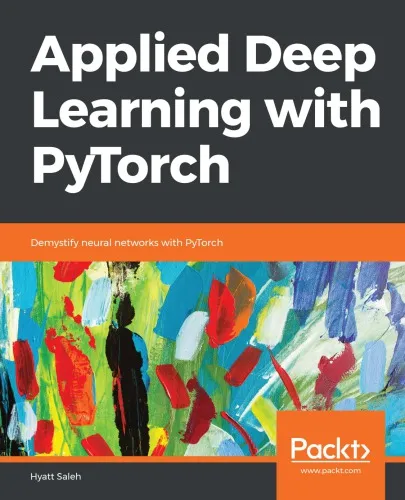
Book guide and evaluation
Saleh,Hyatt
0 reviews
Published
pages
views
Introduction Welcome to "Applied Deep Learning with PyTorch: Demystify Neural Networks with PyTorch," a comprehensive guide crafted to bridge the gap between theoretical knowledge and practical application in deep learning. Whether you are a beginner or an experienced practiti
Before you read
Welcome to "Applied Deep Learning with PyTorch: Demystify Neural Networks with PyTorch," a comprehensive guide crafted to bridge the gap between theoretical knowledge and practical application in deep learning. Whether you are a beginner or an experienced practitioner, this book brings clarity to even the most complex concepts, offering a hands-on approach to mastering neural networks with PyTorch as the cornerstone framework.
This book is more than just a technical manual; it is a journey into the heart of artificial intelligence and machine learning. PyTorch has rapidly gained popularity in the machine learning community for its simplicity, flexibility, and strong community support. By combining real-world examples with in-depth explanations, this book empowers you to apply deep learning techniques confidently across diverse domains.
At its core, "Applied Deep Learning with PyTorch" is designed to demystify the complexities of neural networks by simplifying the pathway toward practical implementation. The book opens with an introduction to foundational concepts and PyTorch basics, ensuring readers build a strong groundwork, even if they come from a non-technical background. By adopting actionable projects and exercises, the book shows readers how to move from theoretical understanding to practical expertise.
This book covers topics like data preprocessing, model architecture design, optimization, and training strategies. From constructing simple models to advanced architectures, such as convolutional neural networks (CNNs) and recurrent neural networks (RNNs), every concept is covered with clarity and hands-on examples. Furthermore, it explores real-world applications in computer vision, natural language processing, and generative modeling, making the content relevant for professionals venturing into productive AI systems.
The book also dives into advanced techniques, such as transfer learning, hyperparameter tuning, and deploying models in production environments. Each chapter is structured to progressively enhance your skill set, ultimately enabling you to tackle complex tasks and build end-to-end deep learning solutions confidently.
"Neural networks are not just mathematical entities—their proper understanding requires intuition, practice, and creativity."
"PyTorch is like a blank canvas for deep learning artists—versatile, powerful, and expressive."
"The beauty of deep learning lies in its ability to mimic human-like intelligence, but the responsibility lies in how we nurture and guide its use."
In a world where artificial intelligence is increasingly shaping industries and influencing how we live, understanding deep learning is no longer optional for those seeking to lead the charge into the future. This book serves as a beacon for professionals, students, and enthusiasts who wish to unravel the mysteries of neural networks and grasp the potential of PyTorch as a framework for rapid yet robust development.
The value of this book lies in its practicality. Instead of wading through abstract mathematical theories, the content focuses on actionable steps and real-world contexts, making it uniquely positioned among deep learning literature. Whether you’re building recommendation systems, enhancing image recognition, or designing chatbots, this book equips you with the skills needed to succeed.
Moreover, PyTorch's dynamic nature allows for better debugging, testing, and experimentation compared to traditional deep learning frameworks. By mastering its features and integrating them with best practices, readers will find themselves well-prepared for high-stakes challenges in data science and AI research.
Your question is answered in the context of this title and author. Each answer uses 2 points.
0 reviews, 4.0 average out of 5
Sign in to publish a review.
Ask a focused question and learn from the community.
Related references that continue this learning path.
Michael Pawlus,Rodger Devine
Akshay Kulkarni,Adarsha Shivananda