

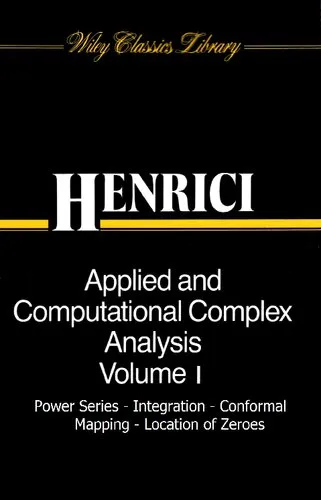
Book guide and evaluation
Applied and Computational Complex Analysis - Vol 1: Power Series, Integration, Conformal Mapping, Location of Zeros
Peter Henrici
English
Beginner
Algebra
4.9 / 5
0 reviews
-
Published
701
pages
290
views
"Applied and Computational Complex Analysis - Vol 1: Power Series, Integration, Conformal Mapping, Location of Zeros" is a definitive textbook that bridges the gap between pure and applied complex analysis. This book combines the theoretical underpinnings of complex variabl
Before you read
What will you get from this book?
"Applied and Computational Complex Analysis - Vol 1: Power Series, Integration, Conformal Mapping, Location of Zeros" is a definitive textbook that bridges the gap between pure and applied complex analysis. This book combines the theoretical underpinnings of complex variable theory with practical computational techniques, making it an invaluable resource for students, researchers, and professionals alike.
Detailed Summary of the Book
Volume 1 of "Applied and Computational Complex Analysis" serves as the foundation for an in-depth exploration of complex analysis, emphasizing its practical applications in engineering, physics, and applied mathematics. The book begins with fundamental concepts such as power series and analytic functions, providing a rigorous yet accessible treatment of the subject. As the chapters progress, readers are introduced to advanced techniques in integration and the intricate methods of conformal mapping, ensuring a thorough understanding of their computational and theoretical aspects.
One of the defining features of this volume is its emphasis on computational approaches. Through a blend of classical methods and numerical algorithms, the book demonstrates how complex analysis can solve real-world problems effectively. From finding the location of zeros to constructing mappings for boundary value problems, the interplay between mathematical rigor and computation is highlighted throughout the text.
Each chapter includes a variety of examples and exercises designed to reinforce key concepts. These practical components are paired with detailed explanations to ensure that readers not only understand the theory but can also apply it to solve problems in diverse scientific and engineering contexts. The first volume lays the groundwork for further studies by carefully building the mathematical tools and intuition necessary for advanced topics in subsequent volumes.
Key Takeaways
- A comprehensive introduction to power series and their application in complex analysis.
- Detailed techniques for integration in the complex plane, including Cauchy's integral theorem and its consequences.
- An in-depth exploration of conformal mapping, emphasizing its use in solving applied problems.
- A structured approach to locating zeros of complex functions using numerical and analytical methods.
- A balanced focus on rigorous mathematics and practical applications, making it suitable for both students and researchers.
- Numerous worked-out examples and exercises to test comprehension and further understanding.
Famous Quotes from the Book
"The true power of complex analysis lies not only in its elegance but also in its ability to simplify and solve real-world problems that elude other methods."
"The union of computational techniques and analytical theory forms the backbone of applied mathematics, and nowhere is this more evident than in complex analysis."
Why This Book Matters
"Applied and Computational Complex Analysis - Vol 1" stands out as one of the most comprehensive and influential textbooks in its field. Its approach merges the elegance of mathematical theory with the pragmatism of computation, producing a resource that is both educational and practical. Complex analysis plays a fundamental role in countless areas of mathematics, science, and engineering, and this book equips readers with the tools necessary to tackle these challenges. Whether you are studying electric fields, fluid flow, or numerical analysis, the concepts within this text provide the basis for countless applications.
Moreover, Henrici’s meticulous writing style ensures that readers are not overwhelmed by abstract concepts but are instead guided step-by-step through the material. The inclusion of computational techniques offers an additional dimension, allowing scientists and engineers to see the direct impact of complex analysis on practical problem-solving. This book is not just a reference—it is a roadmap for anyone hoping to master the intricacies of this vital mathematical discipline.
Ask this book
Your question is answered in the context of this title and author. Each answer uses 2 points.
Sign in to ask the book assistant.
Reader reviews
0 reviews, 4.9 average out of 5
No reviews yet
If you have read this book, help the next reader with your experience.
Write a review
Sign in to publish a review.
Reader questions and answers
Ask a focused question and learn from the community.
Sign in to ask or answer a question.
No questions yet
Be the first to ask a clear, useful question.
What to read next
Related references that continue this learning path.


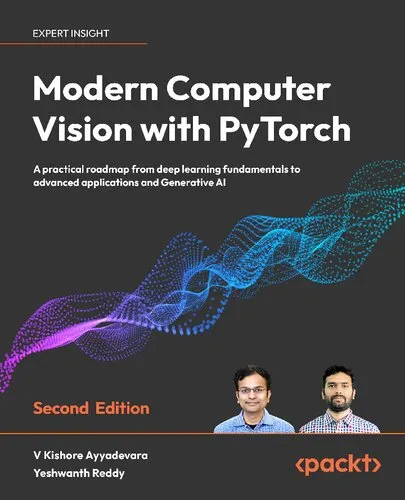
Modern Computer Vision with PyTorch: A Practical Roadmap From Deep Learning Fundamentals to Advanced Applications and Generative AI, 2nd Edition
V Kishore Ayyadevara,Yeshwanth Reddy
2023
View book