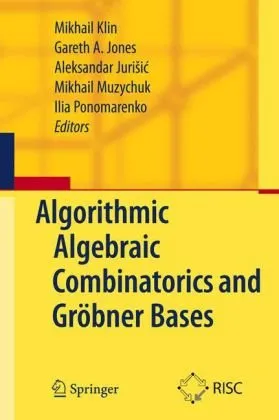
Algorithmic algebraic combinatorics and Grobner bases
Aiso Heinze,Mikhail Klin (auth.),Mikhail Klin,Gareth A. Jones,Aleksandar Jurišić,Mikhail Muzychuk,Ilia Ponomarenko (eds.)
2009
View book
Book guide and evaluation
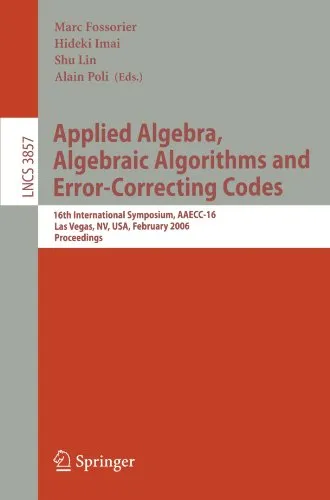
Claude Carlet (auth.),Marc P. C. Fossorier,Hideki Imai,Shu Lin,Alain Poli (eds.)
0 reviews
Published
pages
views
Introduction Welcome to the comprehensive exploration of "Applied Algebra, Algebraic Algorithms, and Error-Correcting Codes: 16th International Symposium, AAECC-16," a pivotal gathering held in Las Vegas, NV, USA, from February 20-24, 2006. This collection of proce
Before you read
Welcome to the comprehensive exploration of "Applied Algebra, Algebraic Algorithms, and Error-Correcting Codes: 16th International Symposium, AAECC-16," a pivotal gathering held in Las Vegas, NV, USA, from February 20-24, 2006. This collection of proceedings is a profound assembly of research, innovations, and discussions, bringing together leading thinkers and practitioners in the fields of algebra and coding theory. Immerse yourself in a world where abstract algebraic notions meet practical algorithmic applications, especially in the context of error-correcting codes, forming the bedrock of reliable data transmission in the digital age.
The book encapsulates the diverse array of papers presented during the symposium, providing valuable insights into contemporary research in applied algebra. Each paper delves into specific areas of study such as algebraic coding theory, cryptography, and computational algebra, offering practical solutions and theoretical advancements. The focus on error-correcting codes is particularly significant, highlighting methods to enhance data fidelity and security in communications technology. This book stands as an academic dialogue, reflecting the dynamic progress in improving the accuracy and efficiency of information systems.
Esteemed academics and industry experts contribute to this volume, ensuring that the proceedings offer thorough analyses and pioneering methods like algebraic geometrical codes, iterative decoding algorithms, and advances in polynomial theory. The integration of algebraic structures with computational strategies is explored in depth, aiming to tackle challenges such as error detection, correction capacities, and the development of algorithms resilient to cyber threats. Ultimately, this compilation is more than a record of presentations; it is a testament to the collective scholarship and invention shaping the future of digital communication.
"The true power of algebraic systems lies in their ability to abstractly model and solve real-world problems."
"Error-correcting codes are not just mathematical curiosities; they are vital for ensuring integrity in digital communication."
As the digital landscape continues to expand, the importance of error-free communication grows exponentially. This symposium's proceedings are crucial for anyone interested in understanding how applied algebra and algorithms underpin every aspect of information technology. The insights shared within these pages not only advance theoretical knowledge but also have tangible implications for industries reliant on accurate data exchange. The ongoing dialogue between algebraists and technologists, as captured in this book, drives the relentless pursuit of innovation, bridging gaps between abstract theory and real-world application.
Furthermore, the collaborative nature of the symposium reflects a global effort to harness the potential of algebraic methods. By delving into these proceedings, readers are invited to join a community dedicated to pushing the boundaries of what is possible, ensuring that the ever-increasing demands for data integrity and security can be met with confidence and foresight. This book is an essential resource for scholars, practitioners, and anyone passionate about the digital revolution and its underpinning mathematical foundations.
Your question is answered in the context of this title and author. Each answer uses 2 points.
0 reviews, 4.7 average out of 5
Sign in to publish a review.
Ask a focused question and learn from the community.
Related references that continue this learning path.
Aiso Heinze,Mikhail Klin (auth.),Mikhail Klin,Gareth A. Jones,Aleksandar Jurišić,Mikhail Muzychuk,Ilia Ponomarenko (eds.)