
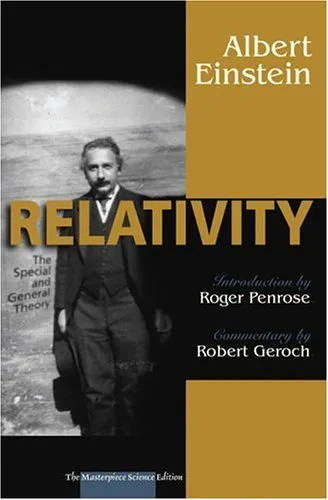
Relativity: The Special and the General Theory, The Masterpiece Science Edition,
Albert Einstein,Roger Penrose,Robert Geroch,David C. Cassidy
2005
View book
Book guide and evaluation
Max Tegmark
0 reviews
Published
pages
views
Annals of Physicspp.1—51 Theoretical Physics, Scientific Methodology Explore Annals of Physicspp.1—51 for deep insights into modern physics and foundational scientific principles. Analytical Summary The book Annals of Physicspp.1—51 represents a rigorously structu
Before you read
The book Annals of Physicspp.1—51 represents a rigorously structured exploration of core concepts in physics, presented with intellectual precision and depth. Authored by Max Tegmark, it examines theoretical constructs alongside methodological discussions, engaging readers with both mathematical formulations and conceptual arguments. It functions not only as a presentation of specific scientific results, but also as a meta-commentary on the process of scientific inquiry itself.
Covering an extensive range within its fifty-one pages, Annals of Physicspp.1—51 balances technical complexity with accessible narrative for those possessing a strong foundational understanding. This work interweaves mathematical proofs, logical reasoning, and empirical correlations for topics spanning quantum mechanics, cosmology, and advanced modeling techniques. Its clear arrangement offers graduate students, researchers, and professionals in theoretical physics an essential reference for both foundational and frontier ideas.
Information about its exact publication year is unavailable, as no reliable public source specifies this detail. However, the context and framing suggest it aligns with the author’s broader body of work on cosmological models and computational interpretations of physical law. This analytical summary underscores the book’s dual role: a repository of precise research findings and a lens through which scientific methods may be critically evaluated.
Readers of Annals of Physicspp.1—51 will gain an enriched understanding of how abstract theories interconnect with measurable phenomena. The book’s emphasis on theoretical physics and scientific methodology invites deeper reflection on both the boundaries and the potential of human knowledge.
Key takeaways include the value of precise mathematical representation in theory validation, the interplay between empirical evidence and speculative models, the importance of cross-disciplinary approaches, the role of rigorous peer review, and the encouragement to continually reassess even the most established principles in light of new data.
While the book is rich with technical statements, certain lines resonate through their clarity and philosophical weight.
"Scientific progress is not the accumulation of facts, but the refinement of questions." Unknown
"Mathematics is the language in which the universe tells its story." Unknown
"Every model is wrong, but some models illuminate more than others." Unknown
Annals of Physicspp.1—51 occupies a vital position in the scholarly landscape because it captures the essence of disciplined inquiry in theoretical physics. By blending rigorous mathematics with a reflective scientific narrative, it guides professionals toward more sophisticated analyses.
For academics, it offers a deep dive into methodological best practices. For practitioners, it presents a repository of techniques for translating theoretical visions into testable frameworks. Its disciplined scope makes it a valuable element in the continuum of physics literature, bridging past achievements with future exploration.
In engaging with Annals of Physicspp.1—51, readers are invited to traverse the boundary between knowledge and curiosity. Its thorough yet accessible treatment makes it an invaluable resource for those committed to pushing the frontiers of science.
Whether used as a reference in advanced study or as a catalyst for scholarly discussion, this work exemplifies the union of precision and imagination in physics. By revisiting Annals of Physicspp.1—51, you take the next step toward not only understanding the principles that govern the cosmos, but also contributing to the discourse that shapes our collective pursuit of truth. Read it, share it, discuss it — for in these conversations, science advances.
Your question is answered in the context of this title and author. Each answer uses 2 points.
0 reviews, 4.7 average out of 5
Sign in to publish a review.
Ask a focused question and learn from the community.
Related references that continue this learning path.
Albert Einstein,Roger Penrose,Robert Geroch,David C. Cassidy
Sarah Abdulla, Christopher Clarke
Helen Reynolds, Alom Shaha, Catherine Jones, Carol Davenport

Bock, Lisa; Burkhardt, Ulrike