![Cover of Statistics: The Art and Science of Learning from Data [RENTAL EDITION]](https://s3.refhub.ir/images/thumb/Statistics__The_Art_and_Science_of_Learning_f_9188.webp)
Book guide and evaluation
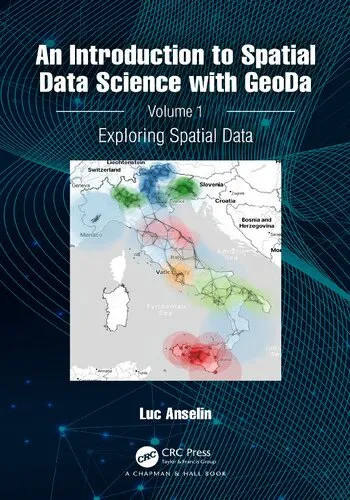
An Introduction to Spatial Data Science with GeoDa, Volume 2: Clustering Spatial Data
Luc Anselin
English
Beginner
Physics
4.5 / 5
0 reviews
2024
Published
238
pages
400
views
An Introduction to Spatial Data Science with GeoDa, Volume 2: Clustering Spatial Data By Luc Anselin Detailed Summary of the Book Spatial data science is an ever-evolving field that bridges the disciplines of geography, statistics, and data science. In 'A
Before you read
What will you get from this book?
An Introduction to Spatial Data Science with GeoDa, Volume 2: Clustering Spatial Data
By Luc Anselin
Detailed Summary of the Book
Spatial data science is an ever-evolving field that bridges the disciplines of geography, statistics, and data science. In 'An Introduction to Spatial Data Science with GeoDa, Volume 2: Clustering Spatial Data', I take readers on a comprehensive journey to understand the complex methodologies behind clustering spatial data using GeoDa, an open-source software designed specifically for geospatial analyses.
This second volume of the series builds on the foundations laid in the first book, shifting focus to more advanced concepts in spatial clustering. By delving into topics such as spatial autocorrelation, k-means analysis, hierarchical clustering, and regionalization, the book not only explains the "how" but also the "why" of clustering when working with spatial datasets. Using GeoDa’s intuitive interface, practical examples, and interactive tools, I demonstrate how clustering can help identify patterns, group similar areas, and offer actionable insights into spatial problems.
Whether you’re analyzing socioeconomic trends across cities or examining environmental patterns in remote regions, this book equips you with the knowledge to make meaningful discoveries. Filled with real-world case studies, expert insights, and hands-on exercises, it is an invaluable guide for both beginners and seasoned professionals looking to expand their expertise in spatial data science.
Key Takeaways
- Comprehensive introduction to clustering spatial data using GeoDa.
- Understanding spatial autocorrelation and its impact on clustering techniques.
- Mastering advanced clustering methods such as k-means, hierarchical clustering, and regionalization.
- Practical applications through hands-on exercises and real-world examples.
- A deep dive into best practices for interpreting and visualizing spatial clusters.
By mastering these concepts, you’ll be well-prepared to tackle challenges across a range of domains, from urban planning and public health to natural resource management and more.
Famous Quotes from the Book
"Spatial clustering not only uncovers hidden patterns but also challenges us to rethink our assumptions about the relationships between places."
"In a connected world, understanding spatial dependence is not optional; it is essential."
"The success of spatial data science lies in the union of mathematical rigor and contextual awareness."
Why This Book Matters
The significance of spatial data science cannot be overstated in today’s data-driven world. Clustering spatial data offers a unique lens through which we can understand complex phenomena such as urban growth, disease outbreak patterns, or changing environmental conditions. This book demystifies these techniques, making them accessible to a broad range of professionals, including geographers, data scientists, urban planners, and policymakers.
What sets 'An Introduction to Spatial Data Science with GeoDa, Volume 2' apart is its combination of theoretical depth and pragmatic guidance. By utilizing GeoDa—a platform specifically designed for spatial data analysis—the book empowers readers to both grasp the mathematical foundations and apply these concepts to their own datasets. Unlike other technical guides, this volume strikes a balance between clarity and complexity, ensuring readers are equipped with actionable skills, not just theoretical understanding.
As spatial data continues to grow in prominence across industries, this book serves as both a foundational resource and an advanced tool for those eager to dive deeper into the field of spatial data science. By understanding the principles and applications of spatial clustering, readers will gain the confidence and expertise necessary to influence decision-making in meaningful ways.
Ask this book
Your question is answered in the context of this title and author. Each answer uses 2 points.
Sign in to ask the book assistant.
Reader reviews
0 reviews, 4.5 average out of 5
No reviews yet
If you have read this book, help the next reader with your experience.
Write a review
Sign in to publish a review.
Reader questions and answers
Ask a focused question and learn from the community.
Sign in to ask or answer a question.
No questions yet
Be the first to ask a clear, useful question.
What to read next
Related references that continue this learning path.
Data Storytelling and Visualization with Tableau: A Hands-on Approach
Prachi Manoj Joshi,Parikshit Narendra Mahalle
2022
View book