Analysis and Algebra on Differentiable Manifolds: A Workbook for Students and Teachers
Prof. P. M. Gadea,Prof. J. Muñoz Masqué (auth.)
2009
View book
Book guide and evaluation
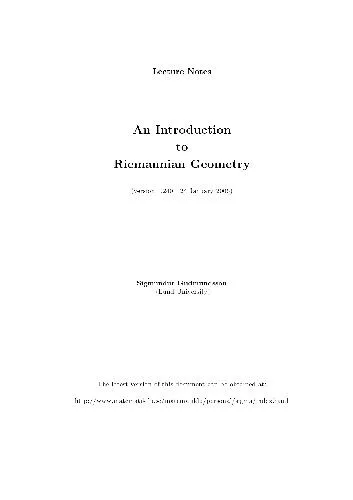
Gudmundsson S.
0 reviews
Published
pages
views
Introduction Welcome to a central work in the field of differential geometry, "An Introduction to Riemannian Geometry" by Gudmundsson S. This book serves as a comprehensive entry point for those eager to explore the intricacies of curved spaces and manifold structures. W
Before you read
Welcome to a central work in the field of differential geometry, "An Introduction to Riemannian Geometry" by Gudmundsson S. This book serves as a comprehensive entry point for those eager to explore the intricacies of curved spaces and manifold structures. Within its pages, readers will discover a meticulous blend of theoretical rigor and insightful interpretations aimed at demystifying Riemannian geometry. The text stands as both an academic resource and a guide for understanding one of the more challenging yet rewarding areas of mathematics.
An Introduction to Riemannian Geometry unravels the complex, multidimensional world of Riemannian manifolds. The book begins with fundamental definitions concerning manifolds and metrics, steering the reader through a systematic study of curvature, geodesics, and topological techniques employed in Riemannian geometry. It progresses to elaborate on the quintessential theorems and propositions that shape our understanding of spatial properties and the intrinsic geometry of surfaces.
The initial chapters focus on providing a solid foundation in differential geometry, ensuring that terms like 'tensor fields' and 'differentiable structures' are not only understood but appreciated for their mathematical elegance. As the narrative unfolds, readers explore advanced topics such as the Ricci flow, sectional curvature, and the role of Riemannian manifolds in general relativity.
This book adeptly balances theoretical discussions with practical applications, connecting abstract concepts with physical models, thereby illustrating the utility of Riemannian geometry in scientific and engineering disciplines.
"In understanding curvature, we find the key to unlocking the very essence of geometric and topological spaces."
"Riemannian geometry not only tells us how to measure distance but reveals the hidden symmetries and frameworks of the universe."
This book holds significance not just for students and educators of mathematics but for anyone interested in the profound ways geometry shapes our understanding of the world. "An Introduction to Riemannian Geometry" stands out for its ability to translate complex mathematical ideas into accessible insights, making it invaluable for both newcomers and seasoned scholars in the field.
In an era where interdisciplinary knowledge is crucial, this book cements Riemannian geometry’s role at the crossroads of physics, engineering, and computer science. Its implications on the theory of general relativity alone showcase its foundational role in explaining the fabric of space-time. Furthermore, its clarity and structure make it an enduring resource that equips readers to tackle advanced topics in manifold theory and beyond.
Your question is answered in the context of this title and author. Each answer uses 2 points.
0 reviews, 4.0 average out of 5
Sign in to publish a review.
Ask a focused question and learn from the community.
Related references that continue this learning path.
Prof. P. M. Gadea,Prof. J. Muñoz Masqué (auth.)