Loading
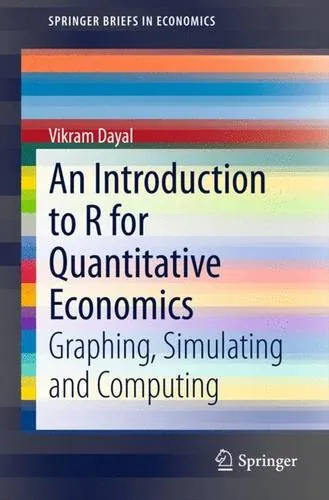
Cover of An Introduction to R for Quantitative Economics: Graphing, Simulating and Computing
English Beginner Artificial Intelligence (AI)

An Introduction to R for Quantitative Economics: Graphing, Simulating and Computing

Vikram Dayal

Vikram Dayal

4.6 / 5

0 reviews

2015

Published

117

pages

325

views

This book gives an introduction to R to build up graphing, simulating and computing skills to enable one to see theoretical and statistical models in economics in a unified way. The great advantage of R is that it is free, extremely flexible and extensible. The book addresses the

About this book

This book gives an introduction to R to build up graphing, simulating and computing skills to enable one to see theoretical and statistical models in economics in a unified way. The great advantage of R is that it is free, extremely flexible and extensible. The book addresses the specific needs of economists, and helps them move up the R learning curve. It covers some mathematical topics such as, graphing the Cobb-Douglas function, using R to study the Solow growth model, in addition to statistical topics, from drawing statistical graphs to doing linear and logistic regression. It uses data that can be downloaded from the internet, and which is also available in different R packages. With some treatment of basic econometrics, the book discusses quantitative economics broadly and simply, looking at models in the light of data. Students of economics or economists keen to learn how to use R would find this book very useful.

Ask this book

Your question is answered in the context of this title and author. Each answer uses 2 points.

Sign in to ask the book assistant.

Reader reviews

0 reviews · 4.6 average out of 5

No reviews yet

If you have read this book, help the next reader with your experience.

Write a review

Sign in to publish a review.

Reader questions and answers

Ask a focused question and learn from the community.

Sign in to ask or answer a question.

No questions yet

Be the first to ask a clear, useful question.

Related references that continue this learning path.