Functional equations and inequalities with applications
Palaniappan Kannappan (auth.)
2009
View book
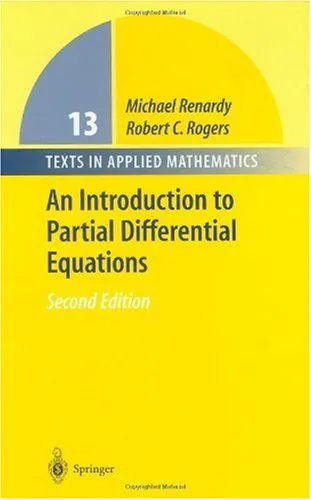
Book guide and evaluation
Michael Renardy Robert C. Rogers
0 reviews
Published
pages
views
Welcome to the comprehensive introduction to "An Introduction to Partial Differential Equations, 2nd Edition". This authoritative text is designed to provide both undergraduate and graduate students a solid foundation in the mathematical theory of partial differential equat
Before you read
Welcome to the comprehensive introduction to "An Introduction to Partial Differential Equations, 2nd Edition". This authoritative text is designed to provide both undergraduate and graduate students a solid foundation in the mathematical theory of partial differential equations (PDEs) and equips them with the necessary tools to apply these concepts in various fields such as physics, engineering, and applied mathematics.
This book dives deep into the core principles of partial differential equations, offering an enriched learning experience through an emphasis on mathematical rigor, extensive problem sets, and practical applications. The authors, Michael Renardy and Robert C. Rogers, present PDEs in a structured manner, beginning with fundamental concepts before progressing to complex problems.
Key topics include first-order equations, second-order linear equations, and the method of characteristics. The book also provides a robust discourse on classical theories, such as those surrounding the wave equation, heat equation, and Laplace's equation. By integrating both classical methodologies and modern techniques, students are encouraged to develop a balanced understanding of PDEs' historical context and current relevance.
Mathematical theories are complemented by thorough illustrative examples, offering readers the unique opportunity to see immediately how the theory is applied in real-world scenarios. This approach not only strengthens comprehension but also engages learners with practical problem-solving exercises designed to internalize knowledge and refine analytical skills.
"The study of mathematics is, at its core, a pursuit of understanding the patterns and structures underlying the complexities of nature."
"Partial differential equations are the language through which we describe the dynamic processes of the universe."
"An Introduction to Partial Differential Equations, 2nd Edition" stands out due to its dual focus on theoretical rigor and practical application. As PDEs serve as indispensable tools in modeling various physical phenomena, a thorough understanding of these equations is crucial for anyone aspiring to make significant contributions to fields such as physics, engineering, and applied mathematics.
This book is particularly valuable for instructors and students alike, as it offers a balanced curriculum grounded in both fundamental theories and modern developments. Its structured presentation ensures that readers not only learn but also engage with the material, fostering a deeper appreciation and stronger command of partial differential equations.
The authors' commitment to delivering clear explanations, alongside examples from real-world applications, positions this book as an essential masterpiece for anyone looking to explore or enforce their understanding of PDEs. Its rich content and pedagogical strengths contribute to its reputation as a critical resource in mathematical education and research.
Your question is answered in the context of this title and author. Each answer uses 2 points.
0 reviews, 4.0 average out of 5
Sign in to publish a review.
Ask a focused question and learn from the community.
Related references that continue this learning path.
Palaniappan Kannappan (auth.)
Michel Chipot,Pavol Quittner
V. I. Lebedev (auth.)