Loading
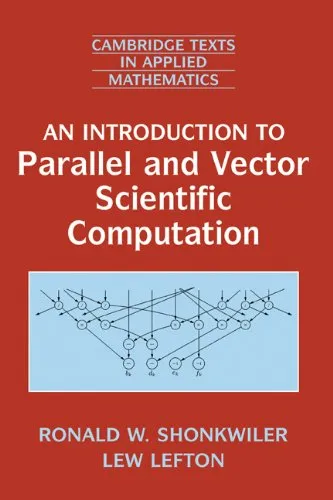
Cover of An introduction to parallel and vector scientific computing
English Intermediate Computer Science and Theory

An introduction to parallel and vector scientific computing

Ronald W. Shonkwiler,Lew Lefton

Lew Lefton

4.4 / 5

0 reviews

2006

Published

303

pages

334

views

In this text, students of applied mathematics, science and engineering are introduced to fundamental ways of thinking about the broad context of parallelism. The authors begin by giving the reader a deeper understanding of the issues through a general examination of timing, data

About this book

In this text, students of applied mathematics, science and engineering are introduced to fundamental ways of thinking about the broad context of parallelism. The authors begin by giving the reader a deeper understanding of the issues through a general examination of timing, data dependencies, and communication. These ideas are implemented with respect to shared memory, parallel and vector processing, and distributed memory cluster computing. Threads, OpenMP, and MPI are covered, along with code examples in Fortran, C, and Java. The principles of parallel computation are applied throughout as the authors cover traditional topics in a first course in scientific computing. Building on the fundamentals of floating point representation and numerical error, a thorough treatment of numerical linear algebra and eigenvector/eigenvalue problems is provided. By studying how these algorithms parallelize, the reader is able to explore parallelism inherent in other computations, such as Monte Carlo methods.

Ask this book

Your question is answered in the context of this title and author. Each answer uses 2 points.

Sign in to ask the book assistant.

Reader reviews

0 reviews · 4.4 average out of 5

No reviews yet

If you have read this book, help the next reader with your experience.

Write a review

Sign in to publish a review.

Reader questions and answers

Ask a focused question and learn from the community.

Sign in to ask or answer a question.

No questions yet

Be the first to ask a clear, useful question.

Related references that continue this learning path.