

Book guide and evaluation
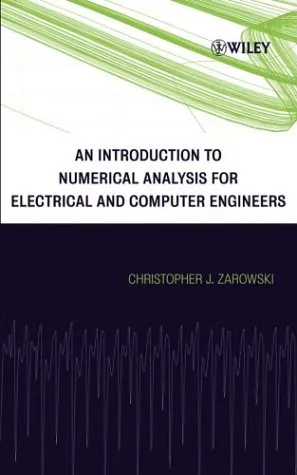
An introduction to numerical analysis for electrical and computer engineers
Christopher J. Zarowski
English
Beginner
Mathematics
4.5 / 5
0 reviews
2004
Published
605
pages
241
views
Introduction to "An Introduction to Numerical Analysis for Electrical and Computer Engineers" Numerical analysis is the cornerstone of solving real-world problems in engineering, particularly in the fields of electrical and computer engineering. "An Introduction to Num
Before you read
What will you get from this book?
Introduction to "An Introduction to Numerical Analysis for Electrical and Computer Engineers"
Numerical analysis is the cornerstone of solving real-world problems in engineering, particularly in the fields of electrical and computer engineering. "An Introduction to Numerical Analysis for Electrical and Computer Engineers" is a carefully crafted resource designed to demystify the core principles of numerical methods while tailoring its application specifically to electrical and computer engineering problems. This book is an indispensable guide for both students and professionals who wish to bridge the gap between theoretical mathematics and practical engineering applications.
A Detailed Summary of the Book
The book is organized to provide a seamless progression from fundamental mathematical concepts to advanced numerical techniques that are critical in engineering practice. It begins by introducing the essential underpinnings of numerical analysis, such as error analysis and approximations, ensuring readers gain a strong foundation. From there, the book delves into key numerical methods, including solution techniques for systems of linear and nonlinear equations, interpolation, numerical differentiation and integration, and eigenvalue problems.
The focus throughout the text lies in demonstrating how these methods can be applied to solve meaningful engineering problems. For instance, topics such as circuit analysis, signal processing, and electromagnetic modeling are revisited through a numerical lens, illustrating their relevance to electrical and computer engineers. Practical insights into software implementations and algorithms are provided, empowering readers to translate theoretical knowledge into computer-based solutions using popular programming tools.
The book is replete with worked examples, illustrative figures, and hands-on exercises, ensuring readers have ample opportunity to practice and apply what they’ve learned. The combination of mathematical rigor, engineering context, and computational applications makes this text both rigorous and accessible.
Key Takeaways
- A solid understanding of the mathematical foundations of numerical methods.
- Practical skills for implementing numerical algorithms in software tools such as MATLAB or Python.
- Techniques for analyzing and minimizing error in numerical computations.
- Applications of numerical analysis to domains like circuit simulation, control systems, and digital signal processing.
- Critical thinking about the limitations and challenges of numerical solutions in engineering practice.
Famous Quotes From the Book
"Numerical analysis is not just about obtaining solutions; it is about understanding the nature of the problem and the reliability of the solutions."
"In engineering, we seldom deal with exact solutions. Numerical methods are how we confidently approximate the complexity of the real world."
"A skilled engineer not only seeks the right method but also recognizes its computational cost and accuracy trade-offs."
Why This Book Matters
In an era dominated by data and computation, numerical methods are essential tools for tackling the increasingly complex challenges faced in engineering disciplines. This book fills a critical gap by presenting numerical analysis with a specific focus on applications in electrical and computer engineering. By treating numerical methods not just as abstract mathematical procedures but as practical tools for solving challenging engineering problems, it provides a unique and highly relevant learning experience.
Furthermore, "An Introduction to Numerical Analysis for Electrical and Computer Engineers" fosters interdisciplinary thinking, preparing students and professionals to apply numerical techniques across various domains of engineering design and analysis. By the end of the book, readers are equipped with the mathematical, computational, and critical thinking skills necessary to approach engineering challenges with confidence.
Whether you are an engineering student seeking to understand the numerical backbone of your discipline or a practicing engineer looking to enhance your analytical skills, this book serves as an invaluable resource. Its blend of theory, practical application, and computational insight ensures it will remain relevant in an ever-evolving technical landscape.
Ask this book
Your question is answered in the context of this title and author. Each answer uses 2 points.
Sign in to ask the book assistant.
Reader reviews
0 reviews, 4.5 average out of 5
No reviews yet
If you have read this book, help the next reader with your experience.
Write a review
Sign in to publish a review.
Reader questions and answers
Ask a focused question and learn from the community.
Sign in to ask or answer a question.
No questions yet
Be the first to ask a clear, useful question.
What to read next
Related references that continue this learning path.



Modern Computer Vision with PyTorch: A Practical Roadmap From Deep Learning Fundamentals to Advanced Applications and Generative AI, 2nd Edition
V Kishore Ayyadevara,Yeshwanth Reddy
2023
View book