Book guide and evaluation
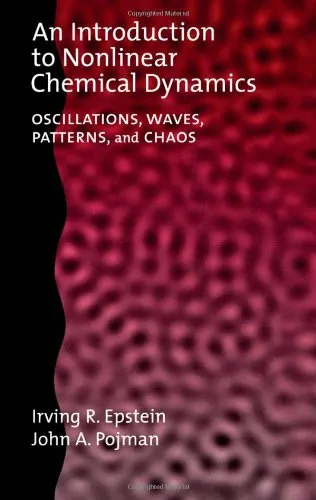
An Introduction to Nonlinear Chemical Dynamics: Oscillations, Waves, Patterns, and Chaos (Topics in Physical Chemistry)
Irving R. Epstein,John A. Pojman
English
Beginner
Physics
4.6 / 5
0 reviews
-
Published
406
pages
396
views
Just a few decades ago, chemical oscillations were thought to be exotic reactions of only theoretical interest. Now known to govern an array of physical and biological processes, including the regulation of the heart, these oscillations are being studied by a diverse group across
Before you read
What will you get from this book?
Just a few decades ago, chemical oscillations were thought to be exotic reactions of only theoretical interest. Now known to govern an array of physical and biological processes, including the regulation of the heart, these oscillations are being studied by a diverse group across the sciences. This book is the first introduction to nonlinear chemical dynamics written specifically for chemists. It covers oscillating reactions, chaos, and chemical pattern formation, and includes numerous practical suggestions on reactor design, data analysis, and computer simulations. Assuming only an undergraduate knowledge of chemistry, the book is an ideal starting point for research in the field. The book begins with a brief history of nonlinear chemical dynamics and a review of the basic mathematics and chemistry. The authors then provide an extensive overview of nonlinear dynamics, starting with the flow reactor and moving on to a detailed discussion of chemical oscillators. Throughout the authors emphasize the chemical mechanistic basis for self-organization. The overview is followed by a series of chapters on more advanced topics, including complex oscillations, biological systems, polymers, interactions between fields and waves, and Turing patterns. Underscoring the hands-on nature of the material, the book concludes with a series of classroom-tested demonstrations and experiments appropriate for an undergraduate laboratory.
Ask this book
Your question is answered in the context of this title and author. Each answer uses 2 points.
Sign in to ask the book assistant.
Reader reviews
0 reviews, 4.6 average out of 5
No reviews yet
If you have read this book, help the next reader with your experience.
Write a review
Sign in to publish a review.
Reader questions and answers
Ask a focused question and learn from the community.
Sign in to ask or answer a question.
No questions yet
Be the first to ask a clear, useful question.
What to read next
Related references that continue this learning path.
![Cover of The Feynman Lectures on Physics [Vol 1]](https://s3.refhub.ir/images/thumb/The_Feynman_Lectures_on_Physics__Vol_1_15281.webp)