
M Dittrich
2025/06/06
5 / 5
great book on science and algorithms
Book guide and evaluation
T.I. Zohdi
1 reviews
Published
pages
views
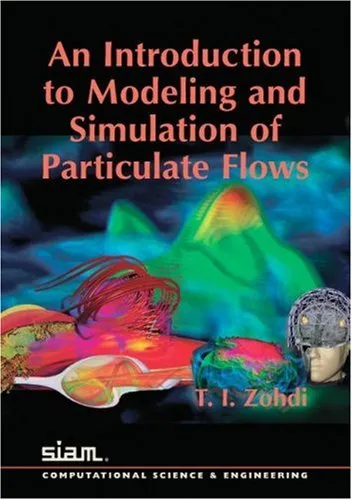
Introduction to "An Introduction to Modeling and Simulation of Particulate Flows (Computational Science and Engineering)" "An Introduction to Modeling and Simulation of Particulate Flows" is a cornerstone text within the domain of computational science and engineering. It
Before you read
"An Introduction to Modeling and Simulation of Particulate Flows" is a cornerstone text within the domain of computational science and engineering. It addresses the complex and ever-evolving field of particulate flows, which are encountered in numerous natural and industrial applications. From sediment transport in rivers to the behavior of granular materials in pharmaceutical processing, understanding particulate flows is pivotal in advancing science and technology. This book serves as an entry point for students, researchers, and professionals aiming to establish a strong foundation in modeling and simulating particulate systems using cutting-edge computational techniques.
Written with clarity and insight, this book bridges the gap between theoretical principles and their practical implementation. It leverages computational tools and models to explore the intricate dynamics of particles suspended in fluid or interacting with solid boundaries. The methods and concepts discussed cater to both analytical minds and engineering practitioners, making it a versatile resource for a broad audience.
The book commences by presenting a thorough background in the fundamentals of particulate flows, covering essential topics such as particle interactions, continuum mechanics, and fluid-particle dynamics. Early chapters ensure that readers with varied backgrounds can comprehend the basic principles before diving into more advanced topics.
As the chapters progress, the focus shifts to computational methods that model particulate behavior at various scales—from single particles to dense suspensions. The book highlights numerical approaches, including finite element methods, discrete element methods (DEM), and computational fluid dynamics (CFD), which are integrated to simulate multiphysical processes. By building simulations that mimic real-world conditions, readers gain the tools needed to solve practical problems found in fields such as manufacturing, bioengineering, and geophysics.
The text further introduces hybrid computational models that combine discrete and continuum approaches, thereby addressing the limitations of traditional methods. Case studies and examples throughout the book demonstrate how these techniques can be applied to complex engineering problems, fostering not only understanding but also the ability to replicate and innovate solutions.
Utilizing an accessible yet rigorous presentation style, the book underscores the importance of accuracy, computational efficiency, and validation when constructing models of particulate flows. With its balance between mathematical exposition and practical applications, this comprehensive guide allows readers to connect theory with implementation.
"Understanding particulate flows is not only a matter of theoretical curiosity but a pressing practical necessity across multiple disciplines."
"Simulation is the bridge that connects the abstract world of mathematics with the tangible realities of engineering design and natural phenomena."
"An Introduction to Modeling and Simulation of Particulate Flows" is a significant contribution to the literature of computational science. Its importance lies in its ability to distill highly complex phenomena into approachable frameworks that readers from diverse fields can understand and apply. The book equips engineers, scientists, and researchers with the knowledge to tackle real-world challenges involving particulate systems—from reducing industrial waste to designing next-generation medical devices.
By focusing on both accuracy and computational practicality, the book sets a benchmark for the development of reliable models in dynamic and multiphysical environments. Furthermore, the integrative approach of combining theoretical foundations with numerical methods ensures that readers not only learn the "how" but also the "why" behind simulation processes. For anyone seeking to deepen their expertise in computational modeling, this text is an invaluable resource that continues to shape advances in the field.
Your question is answered in the context of this title and author. Each answer uses 2 points.
1 reviews, 5.0 average out of 5
2025/06/06
5 / 5
great book on science and algorithms
Sign in to publish a review.
Ask a focused question and learn from the community.
Related references that continue this learning path.



V Kishore Ayyadevara,Yeshwanth Reddy