

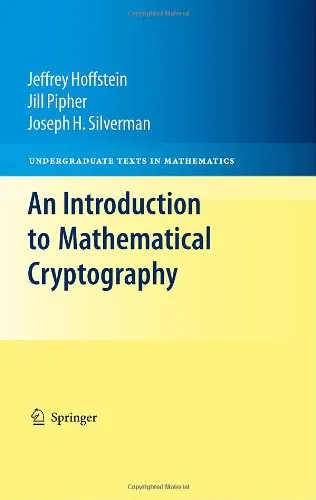
Book guide and evaluation
An introduction to mathematical cryptography
Jeffrey Hoffstein,Jill Pipher,J.H. Silverman
English
Beginner
Mathematics
4.3 / 5
0 reviews
2008
Published
533
pages
289
views
Introduction to "An Introduction to Mathematical Cryptography" Cryptography is an ever-evolving field that lies at the intersection of mathematics and computer science. In our modern digital world, secure communication, data privacy, and robust encryption are not just desirabl
Before you read
What will you get from this book?
Introduction to "An Introduction to Mathematical Cryptography"
Cryptography is an ever-evolving field that lies at the intersection of mathematics and computer science. In our modern digital world, secure communication, data privacy, and robust encryption are not just desirable but necessary. An Introduction to Mathematical Cryptography, authored by Jeffrey Hoffstein, Jill Pipher, and Joseph H. Silverman, serves as a comprehensive gateway to the theoretical foundation and practical applications of cryptography.
Whether you're a student delving into mathematics, a computer scientist exploring security protocols, or an enthusiast passionate about digital privacy, this book offers a deep dive into the mathematical principles that underpin modern cryptographic systems. Widely regarded as a cornerstone text in the subject, it bridges the gap between theory and practice while being accessible to readers with varying mathematical backgrounds.
Detailed Summary of the Book
The book is carefully crafted to provide a strong foundation in the mathematics at the heart of cryptography. Beginning with the fundamentals of number theory, algebra, and probability, the text methodically builds up to advanced topics, including public-key cryptography, elliptic curves, and quantum cryptography. Here's a deeper look into what the book offers:
- The basics of number theory, including prime numbers, modular arithmetic, and finite fields, form the cornerstone of many cryptographic algorithms.
- A detailed study of symmetric-key and public-key cryptography. Protocols such as AES, RSA, Diffie-Hellman, and ElGamal encryption are dissected to illustrate both their utility and mathematical intricacies.
- Elliptic curve cryptography (ECC), an increasingly important topic in modern cryptography, is explored in depth. The book provides a mathematical framework for ECC, making this often-intimidating topic approachable.
- Applications of cryptographic techniques in real-world scenarios. Examples include secure communications, digital signatures, authentication systems, and blockchain technologies.
- Emerging trends in cryptography, such as its role in post-quantum computing and advancements in zero-knowledge proofs, are briefly introduced to spark further curiosity.
The clear style of writing, balanced with rigor and accessibility, makes this book an ideal roadmap for anyone eager to explore cryptography and its mathematical underpinnings.
Key Takeaways
Here are some of the core lessons and insights readers will gain from this book:
- A profound understanding of how mathematical principles are applied to encrypt and secure data.
- An ability to analyze the strengths and weaknesses of different cryptographic algorithms, providing insights into their security guarantees.
- A toolkit of mathematical tools, from modular arithmetic to polynomial rings, which are essential for advancing in the field of cryptography.
- Insight into the challenges of implementing cryptographic systems, particularly in the face of advancing computing power and quantum technologies.
- A roadmap for further exploration into advanced cryptographic research and cutting-edge developments.
Famous Quotes from the Book
"Cryptography is not just about making systems secure but about understanding the mathematical art of problem-solving in the face of adversaries."
"The elegance of modern cryptographic methods lies in their blend of simplicity for users and complexity for attackers."
"Elliptic curves, once a curiosity of pure mathematics, now reside at the core of some of the world's most powerful cryptographic systems."
Why This Book Matters
In a world increasingly reliant on digital communication, understanding cryptography is no longer optional; it is essential. This book demystifies a complex discipline by connecting it to the beauty of pure mathematics and the practical needs of cybersecurity. For students, An Introduction to Mathematical Cryptography serves as a definitive introduction that inspires further study and exploration. For researchers, it is a robust text backed by mathematical rigor and clarity.
Moreover, as the global landscape shifts towards emerging technologies like quantum computing, this book lays a foundation for addressing future challenges in securing our digital infrastructure. It fosters an appreciation for the mathematical innovations that enable privacy and security in an interconnected world, making it an invaluable resource for anyone invested in understanding how cryptography shapes the technology of tomorrow.
Ask this book
Your question is answered in the context of this title and author. Each answer uses 2 points.
Sign in to ask the book assistant.
Reader reviews
0 reviews, 4.3 average out of 5
No reviews yet
If you have read this book, help the next reader with your experience.
Write a review
Sign in to publish a review.
Reader questions and answers
Ask a focused question and learn from the community.
Sign in to ask or answer a question.
No questions yet
Be the first to ask a clear, useful question.
What to read next
Related references that continue this learning path.



Modern Computer Vision with PyTorch: A Practical Roadmap From Deep Learning Fundamentals to Advanced Applications and Generative AI, 2nd Edition
V Kishore Ayyadevara,Yeshwanth Reddy
2023
View book