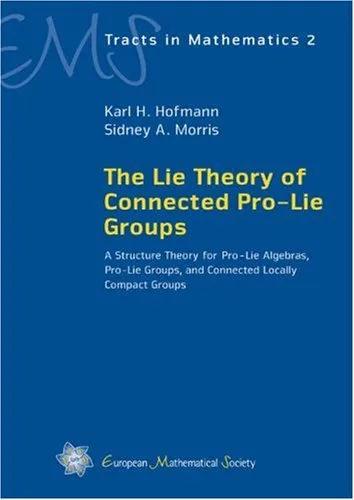
The Lie Theory of Connected Pro-Lie Groups: A Structure Theory for Pro-Lie Algebras, Pro-Lie Groups, and Connected Locally Compact Groups
Karl H. HofmannandSidney A. Morris
2007
View book
Book guide and evaluation
Robert G. Underwood (auth.)
0 reviews
Published
pages
views
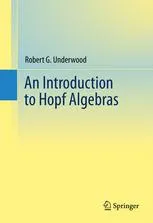
Overview of "An Introduction to Hopf Algebras" Delve into the captivating world of Hopf algebras with Robert G. Underwood's comprehensive guide. This book serves as a foundational resource for those eager to explore the intricate algebraic structures that lie at the heart of m
Before you read
Delve into the captivating world of Hopf algebras with Robert G. Underwood's comprehensive guide. This book serves as a foundational resource for those eager to explore the intricate algebraic structures that lie at the heart of modern mathematical research.
In "An Introduction to Hopf Algebras," Robert G. Underwood introduces readers to the fascinating universe of Hopf algebras, algebraic structures that have applications across diverse areas of mathematics and theoretical physics. The book begins with basic definitions and concepts, gently guiding the reader through group and ring theory fundamentals before venturing into the more complex territories of category theory, tensor products, and duality.
Thely connected to quantum groups, differential geometry, and mathematical physics, Hopf algebras serve as a bridge between algebra and topology. This text provides a detailed exposition of their structure and properties, examining examples, and deriving important results that underscore their significance. Readers will appreciate the logical flow and the carefully selected problems that both challenge and deepen their understanding of the subject.
"The beauty of mathematical structures lies not only in their intricate formalism but also in the unexpected connections they unveil."
"Hopf algebras are to algebra what particles are to physics: fundamental, elusive, and continuously revealing new layers of insight."
Hopf algebras are a cornerstone in the field of modern algebra, offering insights that extend far beyond their theoretical beginnings. "An Introduction to Hopf Algebras" plays a crucial role in demystifying this complex subject for students, educators, and researchers alike.
The book's importance is twofold. First, it serves as an essential primer for those new to the subject, breaking down complex theories into manageable concepts that build upon one another. Second, for the seasoned mathematician, it provides a thorough examination of advanced topics, encouraging the exploration of emerging research areas where Hopf algebra theory continues to evolve.
Robert G. Underwood's meticulous approach ensures that each chapter not only educates but also inspires, fostering a deeper appreciation for the subject's elegance and utility. With Hopf algebras playing an increasingly significant role in mathematical physics, algebraic topology, and representation theory, this work stands as a timely and invaluable resource.
Your question is answered in the context of this title and author. Each answer uses 2 points.
0 reviews, 4.5 average out of 5
Sign in to publish a review.
Ask a focused question and learn from the community.
Related references that continue this learning path.
Karl H. HofmannandSidney A. Morris


Richard P. Feynman,Robert B. Leighton,Matthew Sands