An introduction to the theory of functional equations and inequalities
Marek Kuczma,Attila Gilányi
2008
View book
Book guide and evaluation
Ciarlet P.G.
0 reviews
Published
pages
views
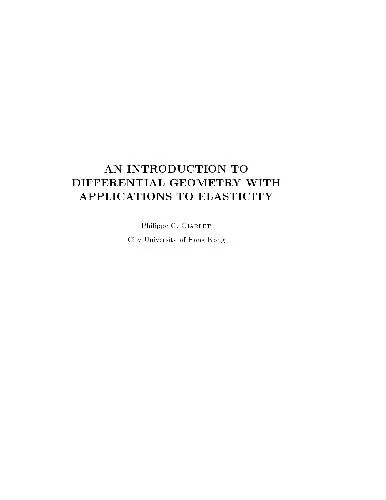
Introduction to the Book "An Introduction to Differential Geometry with Applications to Elasticity" serves as a vital resource for students, researchers, and professionals seeking to explore the connection between the rich field of differential geometry and its profound ap
Before you read
"An Introduction to Differential Geometry with Applications to Elasticity" serves as a vital resource for students, researchers, and professionals seeking to explore the connection between the rich field of differential geometry and its profound applications in elasticity theory. This book, presented in the form of meticulous lecture notes, blends mathematical rigor with practical insights, making complex concepts accessible to readers with a fundamental understanding of differential geometry and mechanics.
Written by Philippe G. Ciarlet, an eminent authority in elasticity and numerical mathematics, this work fills a critical gap in the literature. It stands out not only as a theoretical exposition of differential geometry but also as a practical guide showcasing the interplay between mathematical structures and physical phenomena such as the deformation of elastic bodies. Whether you're a mathematician diving into applied problems or an engineer refining your theoretical toolbox, this book offers something valuable for you.
The book embarks on an educational journey by providing a comprehensive introduction to the fundamental principles of differential geometry, starting with curves, surfaces, and essential mathematical structures such as tangent spaces, curvatures, and metrics. These introductory chapters serve as the groundwork for understanding more complex geometrical ideas.
Building upon this foundation, the book delves into elasticity, focusing on how geometric concepts can enhance our comprehension of elastic deformations, stress tensors, and strain. With clear examples and derivations, Ciarlet illustrates how differential geometry aids in solving practical elasticity problems, particularly for anisotropic and non-linear materials.
During the latter chapters, readers encounter advanced topics, including Riemannian geometry's role in elasticity formulations and the importance of isometric embeddings for surface deformations. Mathematical proofs are meticulously presented alongside physical interpretations, enabling readers to bridge theory and application effectively. The book concludes with significant applications of differential geometry in modeling and analyzing elastic shells, offering modern insights relevant to fields such as mechanical engineering, materials science, and structural mechanics.
"Differential geometry provides the indispensable mathematical language to address problems in elasticity that could neither be formulated nor solved otherwise."
"At the intersection of geometry and mechanics lies an exciting field of study where abstraction meets application."
Today, interdisciplinary knowledge is crucial for tackling real-world challenges. "An Introduction to Differential Geometry with Applications to Elasticity" epitomizes this necessity by demonstrating how advanced mathematical theories can elegantly inform and solve applied problems in mechanics.
This book matters because it bridges two traditionally distinct domains—geometry and elasticity—and presents their integration with unmatched clarity and rigor. Its structured approach equips readers with tools to not only understand abstract theories but also develop solutions to pressing engineering problems. Moreover, by bringing mathematical precision to elasticity, this book contributes to critical advancements in designing like aerospace structures, automotive components, and next-generation materials.
Ultimately, whether you're a mathematician seeking a deeper understanding of elasticity or an engineer needing a robust geometrical foundation, this book serves as both an informative guide and an enduring reference.
Your question is answered in the context of this title and author. Each answer uses 2 points.
0 reviews, 4.7 average out of 5
Sign in to publish a review.
Ask a focused question and learn from the community.
Related references that continue this learning path.
Marek Kuczma,Attila Gilányi

Palaniappan Kannappan (auth.)
Jae-Hyeong Bae,Won-Gil Park (auth.),Themistocles M. Rassias (eds.)