
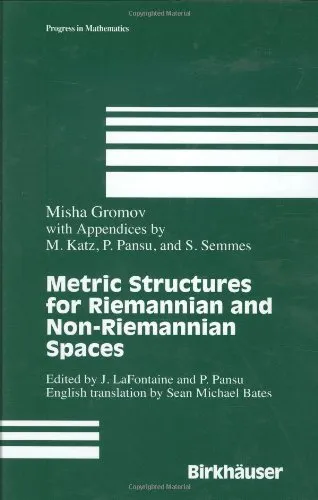
Metric Structures for Riemannian and Non-Riemannian Spaces
Mikhail Gromov,Jacques LaFontaine,Pierre Pansu,S. M. Bates,M. Katz,P. Pansu,S. Semmes
2006
View book
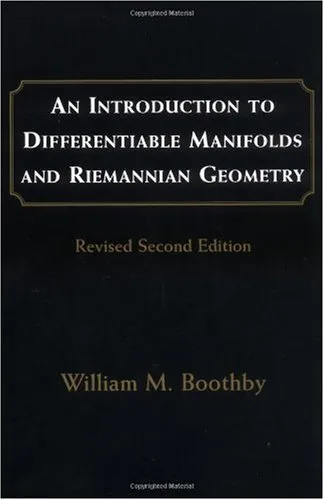
Book guide and evaluation
William M. Boothby,William M. Boothby
0 reviews
Published
pages
views
Introduction Welcome to the enlightening journey into the realms of differential geometry with "An Introduction to Differentiable Manifolds and Riemannian Geometry, Revised, Volume 120, Second Edition (Pure and Applied Mathematics)." As an integral part of the Pure and App
Before you read
Welcome to the enlightening journey into the realms of differential geometry with "An Introduction to Differentiable Manifolds and Riemannian Geometry, Revised, Volume 120, Second Edition (Pure and Applied Mathematics)." As an integral part of the Pure and Applied Mathematics series, this book opens doors to the sophisticated and intricate world of differentiable manifolds and Riemannian geometry, offering a comprehensive resource for students and researchers alike.
This revised edition provides a broad yet coherent overview of the rich mathematical landscape of differentiable manifolds and Riemannian geometry. It delves into foundational concepts essential for understanding the geometry and topology of manifolds, integrating modern approaches that have emerged in the field. Starting with an introduction to manifolds, the book progresses through important topics such as tangent spaces, vector fields, forms, de Rham cohomology, and the significance of Lie groups and Lie algebras.
The exploration of Riemannian geometry is thorough, presenting critical principles such as connections and curvature, geodesics, and the profound Gauss-Bonnet theorem. The text offers numerous examples and illustrations to contextualize these concepts, making them accessible to readers with a basic knowledge of advanced calculus and linear algebra. Designed for both clarity and rigor, the book employs modern mathematical language, serving as a bridge between foundational theory and contemporary research.
"In the study of geometry, the manifold is the stage, and the coordinates are but a fleeting play of numbers."
"Riemannian geometry stands as the harmonious union of algebra and analysis, a canvas upon which the universe’s structure is elegantly painted."
"An Introduction to Differentiable Manifolds and Riemannian Geometry" is not just a textbook; it is a cornerstone resource that bridges academic education and mathematical discovery. Its importance lies in enabling students and experts alike to appreciate and contribute to the field of differential geometry, which is instrumental in modern mathematical physics and numerous scientific disciplines. The book is pivotal for anyone looking to delve deeper into the geometrical structures that shape our mathematical understanding of the world.
The rigorous mathematical exposition combined with practical applications makes this text an indispensable tool for advancing knowledge in the subject. Its inclusion in academic programs underscores its value in fostering a deep appreciation and competence in differentiable manifolds and Riemannian geometry. It equips readers to tackle advanced problems, facilitating a comprehensive mastery of the mathematical principles that underpin much of contemporary scientific inquiry.
Your question is answered in the context of this title and author. Each answer uses 2 points.
0 reviews, 4.0 average out of 5
Sign in to publish a review.
Ask a focused question and learn from the community.
Related references that continue this learning path.
Mikhail Gromov,Jacques LaFontaine,Pierre Pansu,S. M. Bates,M. Katz,P. Pansu,S. Semmes
Mikhail Gromov,M. Katz,P. Pansu,S. Semmes
David Gilbarg,Neil S. Trudinger

P. F. X. Müller,W. Schachermayer