
Book guide and evaluation
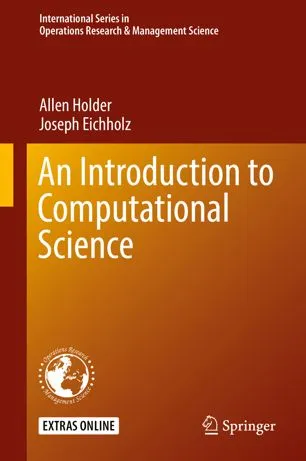
An Introduction to Computational Science
Allen Holder,Joseph Eichholz
English
Beginner
Economics
4.7 / 5
0 reviews
2019
Published
475
pages
174
views
Introduction to "An Introduction to Computational Science" Welcome to An Introduction to Computational Science, a comprehensive guide designed to equip students, educators, and professionals with the knowledge and skills necessary to solve scientific problems u
Before you read
What will you get from this book?
Introduction to "An Introduction to Computational Science"
Welcome to An Introduction to Computational Science, a comprehensive guide designed to equip students, educators, and professionals with the knowledge and skills necessary to solve scientific problems using computational methods. Written by experts in the field, this book bridges the gap between theoretical mathematics, computational programming, and real-world scientific applications. It showcases an elegant synthesis of theory and implementation, allowing readers to understand both the underlying principles and their practical execution.
As computational science continues to grow as an indispensable field across industries, this book provides a solid foundation to help you master its key elements. It is designed to be accessible to readers from a variety of backgrounds, presenting topics clearly and concisely while emphasizing critical thinking and problem-solving skills.
Summary of the Book
This book explores the intersection of science, mathematics, and computing, offering insights into how computational tools and techniques allow scientists to tackle complex problems.
The content is structured to balance theoretical concepts with practical implementation. Key topics include numerical methods, statistical modeling, data visualization, and parallel computing. Each chapter introduces a significant computational science problem and outlines how to solve it with modern tools like Python, MATLAB, and other programming frameworks. The book also emphasizes reproducibility and reliability by discussing computational ethics and validation techniques.
To solidify understanding, the chapters include interactive exercises and coding implementations that demonstrate each concept in action. With examples ranging from climate modeling to bioinformatics, the book highlights the versatility of computational approaches across different scientific realms. Whether you are solving a differential equation or visualizing multidimensional data, An Introduction to Computational Science provides both the conceptual foundations and step-by-step instructions needed to excel.
Key Takeaways
- Understand the fundamental principles of computational science and their applications to real-world challenges.
- Develop skills in numerical analysis, programming, and algorithm design to solve scientific problems programmatically.
- Gain hands-on experience with practical coding examples in popular scientific programming languages.
- Learn to approach problems holistically, analyzing results critically to ensure computational accuracy and reproducibility.
- Explore multidisciplinary applications, including data processing, modeling, and simulation in fields like physics, engineering, biology, and environmental science.
Famous Quotes from the Book
"Computational science is more than just coding; it is a bridge connecting abstract theory to tangible solutions."
"In a world driven by data and algorithms, understanding the 'why' behind computations is as important as the 'how'."
"Science does not advance through isolated discoveries—it thrives on reproducibility, collaboration, and precision."
Why This Book Matters
An Introduction to Computational Science holds immense relevance in today’s world. Computational science is an evolving, interdisciplinary field that empowers researchers to tackle problems once deemed unsolvable due to their scale or complexity. As a guide to this domain, this book fosters critical thinking and analytical skills essential for today’s data-driven scientific landscape.
For students, this book lays the groundwork for future academic and professional success by teaching them concepts that are both robust and versatile. For educators, it offers a well-structured curriculum to introduce computational thinking in the classroom. For professionals, it acts as a valuable resource to deepen understanding and apply computational techniques to diverse challenges.
Moreover, the book emphasizes reproducibility and ethics in computational science, which are increasingly significant as technology shapes the way we approach scientific inquiry. By blending technical detail with a focus on real-world impact, An Introduction to Computational Science empowers its readers to make meaningful contributions wherever computational methods are applied.
Ask this book
Your question is answered in the context of this title and author. Each answer uses 2 points.
Sign in to ask the book assistant.
Reader reviews
0 reviews, 4.7 average out of 5
No reviews yet
If you have read this book, help the next reader with your experience.
Write a review
Sign in to publish a review.
Reader questions and answers
Ask a focused question and learn from the community.
Sign in to ask or answer a question.
No questions yet
Be the first to ask a clear, useful question.
What to read next
Related references that continue this learning path.


Modern Computer Vision with PyTorch: A Practical Roadmap From Deep Learning Fundamentals to Advanced Applications and Generative AI, 2nd Edition
V Kishore Ayyadevara,Yeshwanth Reddy
2023
View book