
Book guide and evaluation
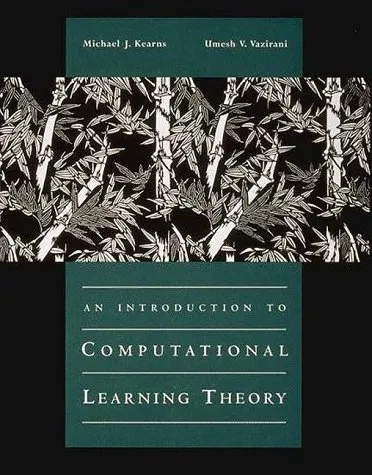
An Introduction to Computational Learning Theory
Michael J. Kearns,Umesh Vazirani
English
Beginner
Machine Learning
4.7 / 5
0 reviews
1994
Published
215
pages
306
views
Emphasizing issues of computational efficiency, Michael Kearns and Umesh Vazirani introduce a number of central topics in computational learning theory for researchers and students in artificial intelligence, neural networks, theoretical computer science, and statistics.Computati
Before you read
What will you get from this book?
Emphasizing issues of computational efficiency, Michael Kearns and Umesh Vazirani introduce a number of central topics in computational learning theory for researchers and students in artificial intelligence, neural networks, theoretical computer science, and statistics.Computational learning theory is a new and rapidly expanding area of research that examines formal models of induction with the goals of discovering the common methods underlying efficient learning algorithms and identifying the computational impediments to learning.Each topic in the book has been chosen to elucidate a general principle, which is explored in a precise formal setting. Intuition has been emphasized in the presentation to make the material accessible to the nontheoretician while still providing precise arguments for the specialist. This balance is the result of new proofs of established theorems, and new presentations of the standard proofs.The topics covered include the motivation, definitions, and fundamental results, both positive and negative, for the widely studied L. G. Valiant model of Probably Approximately Correct Learning; Occam's Razor, which formalizes a relationship between learning and data compression; the Vapnik-Chervonenkis dimension; the equivalence of weak and strong learning; efficient learning in the presence of noise by the method of statistical queries; relationships between learning and cryptography, and the resulting computational limitations on efficient learning; reducibility between learning problems; and algorithms for learning finite automata from active experimentation.
Ask this book
Your question is answered in the context of this title and author. Each answer uses 2 points.
Sign in to ask the book assistant.
Reader reviews
0 reviews, 4.7 average out of 5
No reviews yet
If you have read this book, help the next reader with your experience.
Write a review
Sign in to publish a review.
Reader questions and answers
Ask a focused question and learn from the community.
Sign in to ask or answer a question.
No questions yet
Be the first to ask a clear, useful question.
What to read next
Related references that continue this learning path.
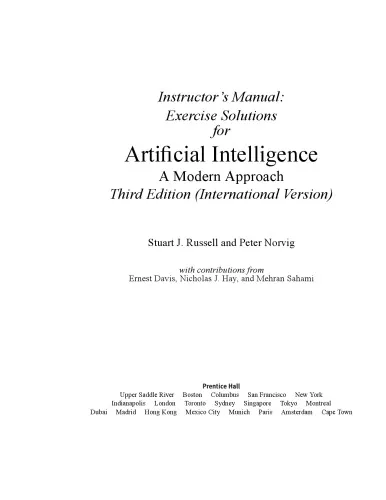
Instructor’s Manual: Exercise Solutions for Artificial Intelligence A Modern Approach - Third Edition
Stuart J. RussellandPeter Norvig
2010
View book
Distributed Artificial Intelligence: A Modern Approach
Satya Prakash Yadav (editor),Dharmendra Prasad Mahato (editor),Nguyen Thi Dieu Linh (editor)
2021
View book