Book guide and evaluation
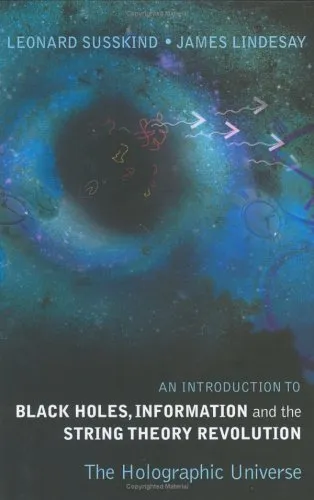
An Introduction to Black Holes, Information And The String Theory Revolution: The Holographic Universe
Leonard Susskind,James Lindesay
English
Beginner
Physics
4.5 / 5
0 reviews
2004
Published
200
pages
420
views
Introduction Welcome to an exhilarating journey through the universe of black holes, information paradoxes, and revolutionary theories that challenge our understanding of reality. "An Introduction to Black Holes, Information and the String Theory Revolution: The Holographi
Before you read
What will you get from this book?
Introduction
Welcome to an exhilarating journey through the universe of black holes, information paradoxes, and revolutionary theories that challenge our understanding of reality. "An Introduction to Black Holes, Information and the String Theory Revolution: The Holographic Universe" by Leonard Susskind and James Lindesay gives readers a peek into the mysterious and profound concepts at the forefront of theoretical physics. This book not only addresses some of the most critical questions in modern physics but also ties them to broader implications for the universe's structure as we understand it. Below, you will find a comprehensive overview of what this pivotal work entails, key extracts to ponder, and reasons why this book holds significance in the scientific community and beyond.
Detailed Summary
This work delves deep into the concept of black holes, those enigmatic celestial objects that have baffled and fascinated astronomers and physicists alike since their theoretical prediction by Karl Schwarzschild in 1916. Black holes serve as crucial test beds for the fundamental laws of physics, particularly blending general relativity with quantum mechanics. Susskind and Lindesay explore how black holes challenge our usual understanding of space and time, leading to the groundbreaking ideas of the holographic principle.
The book is structured around exploring the intricate dances between space, time, and information, ultimately leading to the string theory revolution. This theory, which posits that fundamental particles are not point-like but rather extended objects known as strings, offers a framework for potentially resolving contradictions between quantum mechanics and general relativity.
Key Takeaways
- The role of entropy and information in the context of black holes, leading to paradigm-shifting ideas like the Hawking radiation.
- How the holographic principle suggests that our three-dimensional universe can be described by information encoded on a distant two-dimensional boundary.
- A thorough introduction to string theory, its origins, and its implications for unifying forces of nature.
- A fresh perspective on the quantum mechanics and gravity conundrum, offering resolutions to previously perplexing theoretical difficulties.
Famous Quotes from the Book
"Black holes are where God divided by zero."
"The most incomprehensible thing about the universe is that it is comprehensible."
Why This Book Matters
In a world where scientific breakthroughs challenge our perceptions of reality, this book offers valuable insight into how modern theoretical physics explains those phenomena that once lay beyond scientific understanding. It is written by Leonard Susskind, a prominent figure in theoretical physics who originated the concept of the holographic universe and is a leading proponent of string theory. His collaboration with James Lindesay provides a detailed and accessible exploration of complex ideas, aiming to make such profound topics accessible to students, researchers, or anyone interested in the cosmos.
Like a modern "Principia," this book's revolution lies in the way it synthesizes a diverse range of phenomena under a theoretical umbrella, much like Newton's gravitational theory did centuries ago. It matters not only for its role in academic discourse but also for its contribution to the broader dialogue between science and society, encouraging readers to ponder deep questions about the fabric of reality itself.
Ask this book
Your question is answered in the context of this title and author. Each answer uses 2 points.
Sign in to ask the book assistant.
Reader reviews
0 reviews, 4.5 average out of 5
No reviews yet
If you have read this book, help the next reader with your experience.
Write a review
Sign in to publish a review.
Reader questions and answers
Ask a focused question and learn from the community.
Sign in to ask or answer a question.
No questions yet
Be the first to ask a clear, useful question.
What to read next
Related references that continue this learning path.
Content and Complexity: Information Design in Technical Communication
Michael J. Albers,Beth Mazur,Mary Beth Mazur
2003
View book
The Large Scale Structure of Space-Time: 50th Anniversary Edition
Stephen W. Hawking,George F. R. Ellis
2023
View book