

Book guide and evaluation
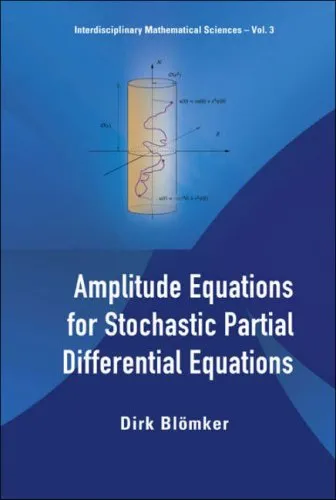
Amplitude Equations for Stochastic Partial Differential Equations
Dirk Blomker
English
Beginner
Mathematics
4.7 / 5
0 reviews
2007
Published
137
pages
178
views
Introduction to "Amplitude Equations for Stochastic Partial Differential Equations" "Amplitude Equations for Stochastic Partial Differential Equations" by Dirk Blömker is an essential resource for researchers, graduate students, and mathematicians working on stoc
Before you read
What will you get from this book?
Introduction to "Amplitude Equations for Stochastic Partial Differential Equations"
"Amplitude Equations for Stochastic Partial Differential Equations" by Dirk Blömker is an essential resource for researchers, graduate students, and mathematicians working on stochastic dynamics, nonlinear systems, and applied analysis. This book delves into the fascinating interplay between randomness and dynamics, focusing on stochastic partial differential equations (SPDEs) and the derivation of amplitude equations as their reduced-order models. With its interdisciplinary approach and mathematical rigor, this text bridges the gap between complex theories and their practical applications in science and engineering. Below, you will find a comprehensive summary, key takeaways, and reasons why this book is a cornerstone in modern mathematical literature.
Detailed Summary of the Book
Stochastic partial differential equations (SPDEs) govern a wide variety of systems impacted by randomness, such as fluid dynamics, population dynamics, and the behavior of complex materials. "Amplitude Equations for Stochastic Partial Differential Equations" introduces the reader to the mathematical framework and analytical tools required to study these equations and their emerging dynamics. In particular, the book emphasizes the derivation of amplitude equations, which are simplified models that describe the evolution of dominant modes in complex systems. By focusing on these reduced-order representations, readers gain insight into the leading-order behavior without becoming overwhelmed by the full complexity of the SPDEs.
Divided into multiple chapters, the book begins with an introduction to SPDEs and their role in modeling physical phenomena. It systematically explores topics such as bifurcation analysis, pattern formation, center manifold theory, and stochastic perturbations. The derivation of amplitude equations is central, bridging nonlinear dynamics and stochastic analysis. The mathematical techniques discussed—including asymptotic expansions, averaging principles, and an analysis of invariant manifolds—are presented in an accessible yet rigorous manner, suitable for readers with a background in differential equations and probability theory.
Throughout the text, examples and case studies are employed to illustrate how amplitude equations can be used effectively to study real-world phenomena. A unique feature of the book is its emphasis on practical applications and interdisciplinary examples, making it a valuable resource for both theorists and applied scientists.
Key Takeaways
- Understand the fundamentals of stochastic partial differential equations and their applications in various fields.
- Learn the methods and principles behind the derivation of amplitude equations as reduced-order models.
- Gain insights into bifurcations and pattern formation in systems affected by noise.
- Explore advanced mathematical tools like asymptotic expansions and center manifold reductions in the SPDE context.
- Recognize the importance of rigorous mathematical modeling in analyzing systems driven by uncertainty.
Famous Quotes from the Book
"Amplitude equations provide a remarkable interplay between simplicity and depth, capturing the essence of complex dynamics in their leading-order behavior."
"The role of randomness in systems is subtle yet profound, often manifesting itself in unexpected patterns and behaviors."
Why This Book Matters
In an increasingly interconnected world driven by complex systems and stochastic effects, the study of SPDEs has never been more critical. Real-world phenomena—from climate modeling to biological systems—often involve an inescapable element of randomness, and this book equips readers to address such challenges mathematically. By focusing on amplitude equations, it highlights the beauty of abstraction in capturing intricate dynamics in a concise manner.
The book's impact extends far beyond mathematics. It is a valuable tool for physicists, engineers, ecologists, and other professionals seeking a deep understanding of uncertainty and noise in nonlinear systems. Furthermore, the approachable yet rigorous style makes it an ideal starting point for graduate students and early-career researchers. By emphasizing practical applications alongside theoretical advancements, Dirk Blömker ensures that this text will remain a cornerstone in this field for years to come.
Ultimately, the book underscores the importance of mathematical analysis in unraveling the complexities of our world. With a focus on both theory and application, it empowers readers to confront the challenges of randomness head-on, making significant contributions to their disciplines and beyond.
Ask this book
Your question is answered in the context of this title and author. Each answer uses 2 points.
Sign in to ask the book assistant.
Reader reviews
0 reviews, 4.7 average out of 5
No reviews yet
If you have read this book, help the next reader with your experience.
Write a review
Sign in to publish a review.
Reader questions and answers
Ask a focused question and learn from the community.
Sign in to ask or answer a question.
No questions yet
Be the first to ask a clear, useful question.
What to read next
Related references that continue this learning path.


Modern Computer Vision with PyTorch: A Practical Roadmap From Deep Learning Fundamentals to Advanced Applications and Generative AI, 2nd Edition
V Kishore Ayyadevara,Yeshwanth Reddy
2023
View book