
Book guide and evaluation
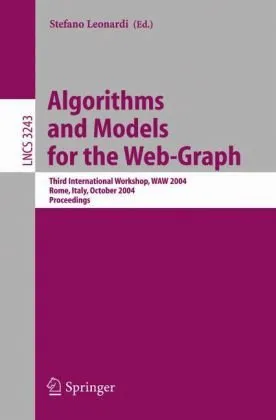
Algorithms and Models for the Web-Graph: Third International Workshop, WAW 2004, Rome, Italy, October 16, 2004, Proceeedings
Béla Bollobás,Oliver Riordan (auth.),Stefano Leonardi (eds.)
English
Beginner
Software Engineering
4.5 / 5
0 reviews
2004
Published
201
pages
127
views
Introduction to "Algorithms and Models for the Web-Graph: Third International Workshop, WAW 2004" The third International Workshop on Algorithms and Models for the Web-Graph (WAW 2004), held in the historic city of Rome, Italy, brought together leading researchers
Before you read
What will you get from this book?
Introduction to "Algorithms and Models for the Web-Graph: Third International Workshop, WAW 2004"
The third International Workshop on Algorithms and Models for the Web-Graph (WAW 2004), held in the historic city of Rome, Italy, brought together leading researchers and practitioners to explore the intricate and increasingly important topic of web graph structures and algorithms. This book encapsulates the groundbreaking findings and discussions from that event, offering a comprehensive and rigorous examination of the state-of-the-art research in this domain. Through its detailed proceedings, readers will gain valuable insights into graph-based algorithms, structural properties of the web graph, and the dynamic growth of web networks.
The web graph, a representation of the World Wide Web as a network of nodes (webpages) and edges (hyperlinks), remains a cornerstone of modern computational research. The explosion of data due to the internet's growth has made understanding these complex graphs vital for developing optimized algorithms, search engines, ranking systems, and social network analyses. This book serves as an in-depth collection of scholarly work presented during the workshop, offering cutting-edge theories, mathematical models, and algorithms tailored to the structure of the web graph.
Edited by Stefano Leonardi and enriched with contributions from renowned researchers such as Béla Bollobás and Oliver Riordan, this volume is a testament to the collaborative effort needed to address the challenges posed by an ever-evolving digital landscape. Whether you're a researcher, student, or professional, the proceedings of WAW 2004 will provide inspiration for tackling real-world web graph problems.
Detailed Summary of the Book
The book is a compilation of research papers and findings presented during the third WAW workshop in 2004. It delves into several key themes, including web graph modeling, algorithmic properties of web data, and statistical analysis of the World Wide Web. The content is organized into distinct sections, each exploring specific challenges and innovations in web graph research.
One primary focus is on understanding the structural properties of web graphs, such as their sparsity, clustering, degree distributions, and small-world characteristics. Researchers present models like the preferential attachment model, which explain the growth and evolution of the web. Additionally, the book introduces algorithms optimized for tasks like page ranking, link prediction, and community detection, vital for search engines and social media platforms.
Several contributions discuss data-mining techniques tailored for large-scale networks, with practical applications ranging from web crawling to spam detection. The interplay between theoretical models and empirical observations provides a holistic understanding of the web graph's dynamics. The book does not merely serve as a record of past research but inspires novel approaches to tackling contemporary internet challenges.
Key Takeaways
- The web graph is a complex, interconnected network whose study requires a confluence of algorithms, statistical models, and computational techniques.
- Structural properties such as the power-law distribution of degrees and the small-world phenomenon are critical to understanding web graph dynamics.
- Both theoretical modeling and data-driven analysis play vital roles in web graph research, with applications extending to search engines, social networks, and recommendation systems.
- Advanced algorithms can significantly improve key web services such as link analysis, ranking, and content personalization.
Famous Quotes from the Book
“The web graph is not just a static object—it is a living, evolving entity shaped by the interactions and behavior of billions of users.”
“Understanding the structure of the web graph is central to unlocking the potential of modern search and ranking algorithms.”
Why This Book Matters
"Algorithms and Models for the Web-Graph: Third International Workshop, WAW 2004" stands at the intersection of mathematics, computer science, and data science. It addresses critical questions about how the web grows, evolves, and is analyzed, offering both theoretical insights and practical applications. The importance of this book lies not just in its historical significance but in its enduring relevance to modern challenges in web science.
The book's emphasis on scalable algorithms and robust models serves as a foundation for creating more efficient search engines, improving the functionality of social networks, and enabling systems to handle the massive scale of web data. For anyone studying the interplay between algorithms and networks or seeking to contribute to the advancement of web technologies, this book provides a treasure trove of knowledge and inspiration.
Ask this book
Your question is answered in the context of this title and author. Each answer uses 2 points.
Sign in to ask the book assistant.
Reader reviews
0 reviews, 4.5 average out of 5
No reviews yet
If you have read this book, help the next reader with your experience.
Write a review
Sign in to publish a review.
Reader questions and answers
Ask a focused question and learn from the community.
Sign in to ask or answer a question.
No questions yet
Be the first to ask a clear, useful question.
What to read next
Related references that continue this learning path.

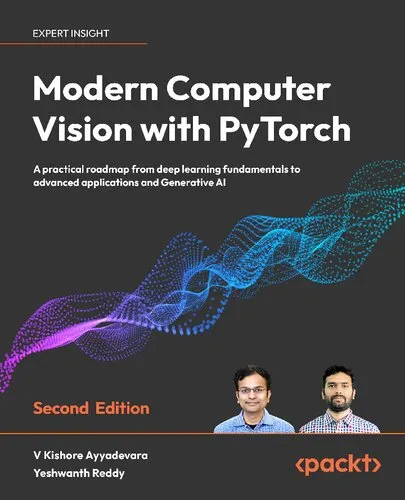
Modern Computer Vision with PyTorch: A Practical Roadmap From Deep Learning Fundamentals to Advanced Applications and Generative AI, 2nd Edition
V Kishore Ayyadevara,Yeshwanth Reddy
2023
View book