
Book guide and evaluation
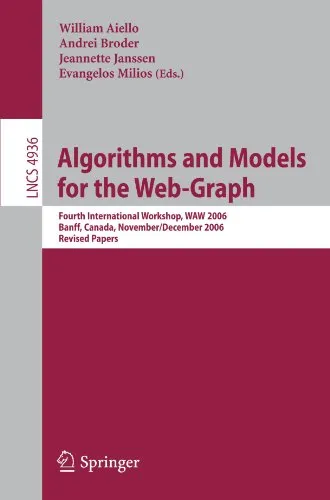
Algorithms and Models for the Web-Graph: Fourth International Workshop, WAW 2006, Banff, Canada, November 30 - December 1, 2006. Revised Papers
William Aiello,Andrei Broder,Jeannette Janssen (auth.),William Aiello,Andrei Broder,Jeannette Janssen,Evangelos Milios (eds.)
English
Beginner
Software Engineering
4.8 / 5
0 reviews
2008
Published
174
pages
202
views
Introduction The rapid expansion of the world wide web has given rise to a plethora of challenges and opportunities in understanding the structure and dynamics of the web graph. The book "Algorithms and Models for the Web-Graph: Fourth International Workshop, WAW 2006, B
Before you read
What will you get from this book?
Introduction
The rapid expansion of the world wide web has given rise to a plethora of challenges and opportunities in understanding the structure and dynamics of the web graph. The book "Algorithms and Models for the Web-Graph: Fourth International Workshop, WAW 2006, Banff, Canada, November 30 - December 1, 2006. Revised Papers" is a pivotal contribution to this field. Serving as a compilation of some of the most innovative and cutting-edge research presented during the WAW 2006 workshop, this publication delves into the mathematical and algorithmic intricacies of studying the web as a graph. By doing so, it provides academics, researchers, and industry practitioners with essential tools and frameworks to analyze the web's ever-evolving complexity.
The workshop from which this book originates brought together world-class researchers who shared insights and breakthroughs in combinatorial, probabilistic, and algorithmic techniques for analyzing the web graph. The revised papers featured in this volume undergo rigorous peer review and offer sharp perspectives on key topics, such as web crawling, link prediction, ranking algorithms, scale-free networks, and graph generation models. This book is therefore not just a report or conference volume—it is a cornerstone reference for anyone seeking to deeply understand the web graph's structures and behaviors.
Detailed Summary
This book is a carefully curated collection of revised papers addressing a wide range of topics associated with the web graph. Its content is divided into discussions on algorithms, models, and empirical data analysis related to the structure and growth of web graphs. Each contribution offers a unique perspective while building upon foundational theories and practical applications.
The authors explore advanced mathematical models that describe the topology of web graphs, weaving together concepts such as degree distributions, clustering coefficients, and community structures. This leads to a broader understanding of the web as a dynamic entity that shifts with users’ interactions over time. Furthermore, the book delves into efficient algorithms for web crawling, addressing the scalability challenges posed by the exponential growth of the web. These algorithms focus on balancing breadth and depth while optimizing speed and data accuracy.
Another critical contribution lies in predictive modeling of web behavior. The authors present algorithms for link prediction and growth modeling that examine how new connections emerge within the web graph. These insights illuminate why certain pages gain prominence while others fade into obscurity. Ranking mechanisms, including an analysis of the theoretical underpinnings of influential algorithms like PageRank and HITS, are also discussed in detail, applying these models to better understand the mechanisms behind search results.
Key Takeaways
- A deeper understanding of graph models that replicate the web's scale-free properties and clustering behavior.
- Insights into the effectiveness and limitations of algorithms that power web analytics, search engines, and web crawlers.
- Emerging techniques in link prediction and community detection within web graphs.
- Critical advancements in ranking algorithms and the mathematics behind prioritizing content in search results.
- The application of probabilistic methods and empirical analysis to enhance the scalability of web systems.
Famous Quotes from the Book
"The web graph is not merely a collection of connected pages; it is a living, breathing entity that evolves as society's patterns and preferences shift."
"Understanding the intricate mathematics behind the web graph is akin to decoding the DNA of the internet."
"Graph theory, when applied to the web, transforms mere data into powerful insights that shape the digital economy."
Why This Book Matters
As the world continues to rely on the web for critical functions—from business and education to social networking and entertainment—understanding its underlying structure becomes imperative. This book bridges the gap between theoretical graph models and their real-world applications in web analysis. Its relevance is magnified in an era where the web is increasingly central to all aspects of life.
The contributions in this book are not only of academic interest but also possess significant practical value. Search engines rely heavily on algorithms like those discussed in the book, and businesses stand to benefit from the predictive models that explain user behavior and link formation. Furthermore, the insights gained from this book can be extended to other networked systems, such as social networks, citation networks, and biological graphs, making its impact far-reaching.
Ask this book
Your question is answered in the context of this title and author. Each answer uses 2 points.
Sign in to ask the book assistant.
Reader reviews
0 reviews, 4.8 average out of 5
No reviews yet
If you have read this book, help the next reader with your experience.
Write a review
Sign in to publish a review.
Reader questions and answers
Ask a focused question and learn from the community.
Sign in to ask or answer a question.
No questions yet
Be the first to ask a clear, useful question.
What to read next
Related references that continue this learning path.

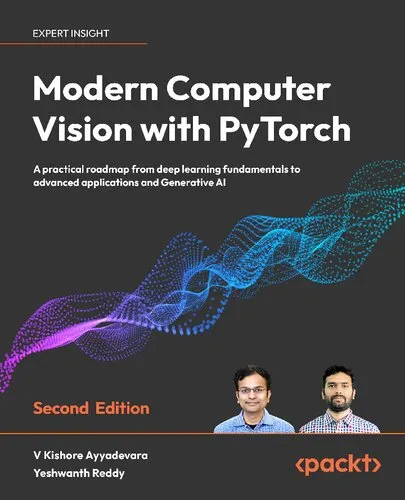
Modern Computer Vision with PyTorch: A Practical Roadmap From Deep Learning Fundamentals to Advanced Applications and Generative AI, 2nd Edition
V Kishore Ayyadevara,Yeshwanth Reddy
2023
View book