

Book guide and evaluation
Algorithms and Models for the Web-Graph: 6th International Workshop, WAW 2009, Barcelona, Spain, February 12-13, 2009. Proceedings
Kevin J. Lang (auth.),Konstantin Avrachenkov,Debora Donato,Nelly Litvak (eds.)
English
Beginner
Software Engineering
4.2 / 5
0 reviews
2009
Published
192
pages
102
views
Introduction to "Algorithms and Models for the Web-Graph: 6th International Workshop, WAW 2009" The rapid expansion of the World Wide Web has introduced a vast and intricate web of interconnected data that has reshaped how humans interact, communicate, and organize information
Before you read
What will you get from this book?
Introduction to "Algorithms and Models for the Web-Graph: 6th International Workshop, WAW 2009"
The rapid expansion of the World Wide Web has introduced a vast and intricate web of interconnected data that has reshaped how humans interact, communicate, and organize information. Understanding the structure, behavior, and algorithms underpinning the web graph is critical for researchers, practitioners, and technologists aiming to develop more efficient and scalable systems. This book, "Algorithms and Models for the Web-Graph," compiles cutting-edge insights and research presented at the 6th International Workshop, WAW 2009, held in Barcelona, Spain, February 12-13, 2009.
Detailed Summary of the Book
The "Algorithms and Models for the Web-Graph" series of workshops has become a prominent platform for the exchange of both theoretical and practical advancements in the field of web graph analytics. In this 6th volume, the proceedings encapsulate innovative research contributions addressing the core challenges and opportunities in studying massive web structures, graph algorithms, and network evolution models.
The workshop encompasses a wide array of topics, which include but are not limited to:
- Theoretical models for web graphs and understanding their growth dynamics.
- Efficient algorithms for ranking, searching, and traversing the web graph.
- Applications of graph algorithms in areas like search engines, recommendation systems, and spam detection.
- Analyzing user interactions and behavior in online networks.
With contributions from celebrated researchers, the book includes seminal works that explore graph models such as preferential attachment, small-world properties, and methods to compute properties like connectivity, centrality, and clustering coefficients. Moreover, it examines real-world datasets, bridges the gap between theory and practice, and provides insights into computational challenges posed by massive web graphs.
Key Takeaways
This book offers invaluable learning opportunities for anyone interested in algorithms, data science, and web graph analysis. Here are some of the key takeaways:
- Gain a deeper understanding of essential graph-theoretic concepts and their application to web data.
- Explore how different models replicate real-world web graph structures efficiently.
- Learn scalable methods for tackling challenges such as link prediction, ranking, and spam filtering on enormous graphs.
- Understand the intersection of machine learning, graph theory, and big data as they apply to web analytics.
The collected proceedings also emphasize how algorithmic enhancements can improve practical tools such as search engines, social network analysis platforms, and collaborative filtering systems.
Famous Quotes from the Book
While the book primarily comprises technical papers, it includes profound insights and statements that illustrate the importance of this field. Two notable quotes are:
"The web is not only a graph of information, but also a graph of human intention, collaboration, and interaction."
"Modeling the complex and evolving web graph requires simplifying assumptions, yet these abstractions yield profound insights."
These words reflect the duality of the web graph — as a technical structure and a mirror of human behavior — and the necessity for both models and algorithms to balance simplicity and complexity.
Why This Book Matters
In the era of big data, artificial intelligence, and growing digital interconnectivity, understanding the web graph is no longer optional. As businesses, governments, and individuals depend heavily on web technologies, research in this area is more relevant than ever.
This book matters because it serves as a comprehensive resource for those looking to stay at the forefront of web-based research and innovation. By compiling the latest studies, it provides a snapshot of where the field stood in 2009 — a critical period for web graph advancements. The WAW 2009 proceedings offer timeless methodologies and insights that continue to shape modern technologies, including personal recommendation systems, community detection algorithms, and web-scale ranking models.
Additionally, the international nature of this workshop fosters cross-discipline collaboration by bridging researchers from computer science, mathematics, and data science. This collection of papers promotes diverse perspectives and a shared vision of advancing web-related technologies.
Whether you're an academic, a developer, or simply fascinated by the underpinnings of the web, "Algorithms and Models for the Web-Graph: 6th International Workshop, WAW 2009" is an essential resource for delving into the complex but fascinating world of web graphs.
Ask this book
Your question is answered in the context of this title and author. Each answer uses 2 points.
Sign in to ask the book assistant.
Reader reviews
0 reviews, 4.2 average out of 5
No reviews yet
If you have read this book, help the next reader with your experience.
Write a review
Sign in to publish a review.
Reader questions and answers
Ask a focused question and learn from the community.
Sign in to ask or answer a question.
No questions yet
Be the first to ask a clear, useful question.
What to read next
Related references that continue this learning path.

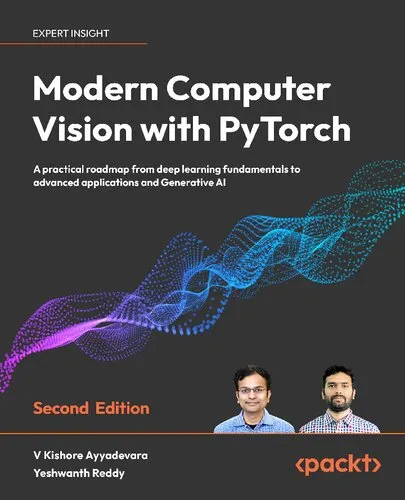
Modern Computer Vision with PyTorch: A Practical Roadmap From Deep Learning Fundamentals to Advanced Applications and Generative AI, 2nd Edition
V Kishore Ayyadevara,Yeshwanth Reddy
2023
View book