
Book guide and evaluation
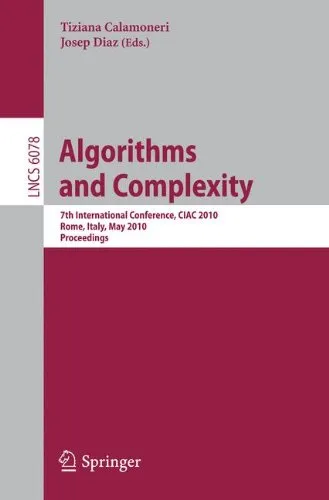
Algorithms and Complexity: 7th International Conference, CIAC 2010, Rome, Italy, May 26-28, 2010. Proceedings
Ricardo Baeza-Yates (auth.),Tiziana Calamoneri,Josep Diaz (eds.)
English
Beginner
Art
4.3 / 5
0 reviews
2010
Published
382
pages
186
views
Introduction Welcome to the proceedings of the 7th International Conference on Algorithms and Complexity (CIAC 2010), held in the historic city of Rome, Italy, from May 26-28, 2010. This book is a testament to the vibrant and ever-evolving field of algorithms and computational
Before you read
What will you get from this book?
Introduction
Welcome to the proceedings of the 7th International Conference on Algorithms and Complexity (CIAC 2010), held in the historic city of Rome, Italy, from May 26-28, 2010. This book is a testament to the vibrant and ever-evolving field of algorithms and computational complexity, bringing together cutting-edge research, innovative solutions, and foundational insights from experts around the globe.
Algorithms and complexity are at the heart of theoretical computer science. They shape our understanding of computational efficiency and resource constraints while driving technological progress in areas such as data science, artificial intelligence, networking, and beyond. CIAC 2010 highlighted significant advancements and covered a range of topics spanning from fundamental algorithmic questions to practical applications of complexity-oriented techniques.
This collection of meticulously selected papers, peer-reviewed by leading experts, reflects the diversity and depth of the research presented during the conference. The goal of this book is twofold: to provide readers with a cohesive account of the latest developments in algorithms and serve as an invaluable resource for both researchers and practitioners in the computing community.
Detailed Summary of the Book
The contents of this book are divided into carefully curated sections, covering a rich spectrum of topics in algorithm design, analysis, and computational complexity.
Key areas of focus include graph algorithms, approximation and online techniques, data structures, dynamic programming, randomized algorithms, and computational models. Particular attention is given to solving real-world problems and improving the efficiency of algorithms to address resource constraints such as time and memory limits. From classic problems like shortest paths and network flows to emerging challenges in bioinformatics and distributed computing, this book serves as a comprehensive guide to the latest developments.
Each paper delves deeply into a specific topic, presenting new methods, rigorous proofs, and experimental results. The authors provide in-depth analyses and contextualize their findings within the broader landscape of computer science, helping readers understand both theoretical and practical implications.
Key Takeaways
- Advances in graph algorithms are paving the way for more efficient problem-solving in large-scale networks, including transportation, social media, and communication platforms.
- New approximation techniques significantly improve the efficiency of solving NP-hard problems, demonstrating practical value in settings where exact solutions are computationally infeasible.
- Innovative data structures introduced in this collection enhance both storage capacity and operation speeds, addressing the demands of modern applications.
- Randomized and online algorithms are highlighted as critical tools in scenarios with real-time decision-making and incomplete information.
- Theoretical breakthroughs in computation models and complexity provide a better understanding of the boundaries of feasible computation.
Famous Quotes from the Book
“The elegance of an algorithm lies not just in its efficiency but also in its adaptability across varying computational paradigms.”
“Finding the balance between theoretical rigor and practical applicability is the cornerstone of impactful algorithm design.”
“As our computational models evolve, so too must our understanding of complexity—a journey that merges logic, mathematics, and creativity.”
Why This Book Matters
In an era defined by data and algorithms, understanding the principles and complexities of computation is more important than ever. This book captures the state-of-the-art research in algorithms and complexity, offering detailed solutions to problems that have a widespread impact on modern science, engineering, and industry.
Beyond its academic importance, the content of this book provides essential tools and perspectives for addressing real-world challenges. Whether you are a researcher seeking inspiration, a practitioner looking for efficient solutions, or a student eager to explore the depths of computing, this book is a treasure trove of knowledge. It bridges the gap between theory and practice, offering insights that fuel innovation and discovery.
The CIAC conference series, and this book as its latest milestone, serve as a testament to the collaborative and interdisciplinary nature of computational research. By bringing together brilliant minds from around the globe, it highlights the collective effort needed to push the boundaries of what is computationally possible.
Ask this book
Your question is answered in the context of this title and author. Each answer uses 2 points.
Sign in to ask the book assistant.
Reader reviews
0 reviews, 4.3 average out of 5
No reviews yet
If you have read this book, help the next reader with your experience.
Write a review
Sign in to publish a review.
Reader questions and answers
Ask a focused question and learn from the community.
Sign in to ask or answer a question.
No questions yet
Be the first to ask a clear, useful question.
What to read next
Related references that continue this learning path.


Modern Computer Vision with PyTorch: A Practical Roadmap From Deep Learning Fundamentals to Advanced Applications and Generative AI, 2nd Edition
V Kishore Ayyadevara,Yeshwanth Reddy
2023
View book