
Book guide and evaluation
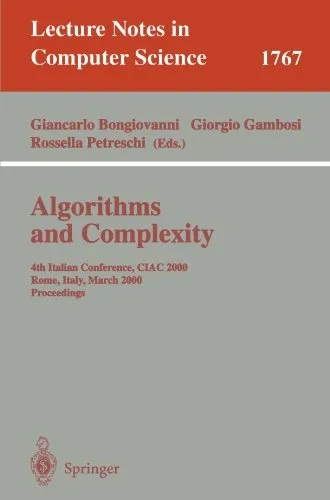
Algorithms and Complexity: 4th Italian Conference, CIAC 2000 Rome, Italy, March 1–3, 2000 Proceedings
Giorgio Ausiello,Stefano Leonardi,Alberto Marchetti-Spaccamela (auth.),Giancarlo Bongiovanni,Rossella Petreschi,Giorgio Gambosi (eds.)
English
Beginner
Software Engineering
5.0 / 5
0 reviews
2000
Published
324
pages
148
views
Introduction to 'Algorithms and Complexity: 4th Italian Conference, CIAC 2000' Welcome to the proceedings of the 4th Italian Conference on Algorithms and Complexity (CIAC 2000), a prestigious gathering of researchers in the dynamic fields of theoretical and applied computer
Before you read
What will you get from this book?
Introduction to 'Algorithms and Complexity: 4th Italian Conference, CIAC 2000'
Welcome to the proceedings of the 4th Italian Conference on Algorithms and Complexity (CIAC 2000), a prestigious gathering of researchers in the dynamic fields of theoretical and applied computer science. Held in the heart of Rome from March 1–3, 2000, this conference brought together some of the most prominent names in algorithmic research to share groundbreaking findings and foster intellectual discourse. Within these pages, you will find a collection of papers that delve into the latest advancements in algorithmic design, complexity theory, and computational mathematics.
The proceedings serve as a rich resource for anyone involved in the study or application of algorithms and computational theory. Edited by Giancarlo Bongiovanni, Rossella Petreschi, and Giorgio Gambosi, this book offers detailed insights into the challenges and innovative solutions that were critical to the computational landscape of the early 21st century. Whether you are a seasoned professional, a student entering the field, or simply an enthusiast of computational problem-solving techniques, this book provides a comprehensive foundation for further exploration and learning.
Detailed Summary of the Book
Each chapter of this book represents a snapshot of the rigor and creativity displayed by researchers at the CIAC 2000 conference. Topics covered include but are not limited to graph algorithms, combinatorial optimization, approximation techniques, computational geometry, and complexity classes. A key focus of the conference proceedings is the exploration of practical methodologies for computational problems, alongside theoretical analyses to deepen understanding of fundamental computational limits.
The papers delve into cutting-edge topics such as parallel algorithms, distributed computing, randomness in algorithm design, and real-world applications in fields ranging from bioinformatics to network optimization. These proceedings underscore the unique role algorithms play in modern society, driving efficiency in data processing, system optimization, and decision-making processes.
What sets this book apart is its balance between theoretical frameworks and practical applications. It addresses the curiosity of academicians while being accessible to practitioners who aim to apply these methods in solving pressing real-world issues.
Key Takeaways
- An exploration of novel graph algorithms and their applications in network design and logistics.
- Insight into complexity theory, helping delineate the boundaries between efficient and intractable problems.
- Techniques for approximation algorithms addressing NP-hard problems, providing near-optimal solutions within known error bounds.
- Practical applications of algorithms in emerging fields like bioinformatics and data mining.
- Discussions of parallel and distributed computing challenges in large-scale systems.
Famous Quotes from the Book
"Understanding the complexity of a problem is the cornerstone of designing efficient algorithms."
"Approximation is not a weakness but a necessary and powerful strategy when faced with intractable problems."
Why This Book Matters
At its core, 'Algorithms and Complexity: 4th Italian Conference, CIAC 2000' is not merely a collection of academic papers; it is a testament to the collective effort of the computational science community to tackle some of the most pressing challenges in algorithm design and optimization. Its relevance extends far beyond its time of publication, offering insights that continue to influence the ways we think about solving computational problems.
This book is crucial for shedding light on how algorithmic research evolved at the dawn of the 21st century. By bridging theory and practice, it demonstrates how algorithms can transform abstract mathematical concepts into powerful tools that influence diverse areas such as artificial intelligence, cryptography, and operational research. It reminds us that the pursuit of efficiency and optimization lies at the heart of technological progress. Whether you are conducting research, designing software systems, or studying computational theory, this book provides a treasure trove of knowledge that remains relevant today.
Ask this book
Your question is answered in the context of this title and author. Each answer uses 2 points.
Sign in to ask the book assistant.
Reader reviews
0 reviews, 5.0 average out of 5
No reviews yet
If you have read this book, help the next reader with your experience.
Write a review
Sign in to publish a review.
Reader questions and answers
Ask a focused question and learn from the community.
Sign in to ask or answer a question.
No questions yet
Be the first to ask a clear, useful question.
What to read next
Related references that continue this learning path.

Modern Computer Vision with PyTorch: A Practical Roadmap From Deep Learning Fundamentals to Advanced Applications and Generative AI, 2nd Edition
V Kishore Ayyadevara,Yeshwanth Reddy
2023
View book