
Book guide and evaluation
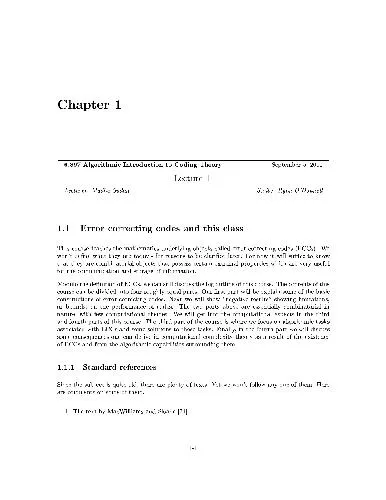
Algorithmic Introduction to Coding Theory
Sudan M.
English
Beginner
Software Engineering
5.0 / 5
0 reviews
2001
Published
154
pages
186
views
Introduction to "Algorithmic Introduction to Coding Theory" Welcome to the exploration of "Algorithmic Introduction to Coding Theory," a meticulously crafted book designed to provide readers with a rich insight into the fascinating and practical world of error-correcti
Before you read
What will you get from this book?
Introduction to "Algorithmic Introduction to Coding Theory"
Welcome to the exploration of "Algorithmic Introduction to Coding Theory," a meticulously crafted book designed to provide readers with a rich insight into the fascinating and practical world of error-correcting codes. From foundational mathematical theory to cutting-edge algorithms, this book is tailored for both computer scientists and mathematicians seeking clarity and depth in one of the most critical areas of modern computing.
Coding theory is a versatile discipline at the intersection of mathematics, computer science, and communication engineering. With real-world applications ranging from data transmission, cryptography, and coding compression to computer memory systems and satellite communication, it has shaped how information is shared and protected in the digital age. This book serves as a comprehensive guide to mastering its theoretical and practical aspects, emphasizing algorithmic approaches and problem-solving.
Detailed Summary of the Book
The book begins by introducing essential concepts and definitions in coding theory, providing readers with a solid foundation to tackle more advanced topics. Topics such as linear error-correcting codes, Hamming codes, and Reed-Solomon codes are introduced early on, with a focus on their encoding, decoding, and error-detection properties.
As the book progresses, readers are exposed to more sophisticated topics in coding theory, including cyclic codes, BCH codes, convolutional codes, and iteratively-decodable codes. What sets this book apart is its emphasis on the algorithmic aspects of the subject. Advanced decoding algorithms, complexity considerations, and practical case studies are presented to pave the way for real-world application and research.
Furthermore, the book delves into the mathematical underpinnings of coding theory, exploring abstract algebraic concepts like finite fields and polynomial rings where necessary. The author provides intuitive explanations while maintaining a formal rigor, ensuring clarity without oversimplification. Each chapter is supplemented with illustrative examples, exercises, and computational problems that reinforce learning and encourage deeper engagement with the material.
Key Takeaways
- A robust understanding of essential coding theory concepts such as Hamming distance, parity-check matrices, and generator matrices.
- An algorithmic perspective on error-correcting codes with a focus on concepts like syndrome decoding, cyclic redundancy checks, and iterative decoding methods.
- Insight into the applications of coding theory in communication systems, cryptography, data storage, and secure information transfer.
- Problem-solving techniques with hands-on exercises that bridge theory and practice, making the subject accessible to self-learners and students.
- A clear, concise, and approachable treatment of complex mathematical concepts necessary for coding theory, including finite fields and abstract algebraic structures.
Famous Quotes from the Book
"An efficient code is not one that merely compresses or transmits data but one that embeds within itself the capacity to overcome noise and errors, enabling flawless communication in imperfect conditions."
"Coding theory is, at its heart, a triumph of abstraction—demonstrating how pure mathematical ideas can solve deeply practical problems in the real world."
Why This Book Matters
Coding theory may appear niche, but its impact resonates across virtually every technological domain. This book matters because it provides a rigorous but accessible introduction to a critical field that underpins the digital world. Whether you're uploading photos to the cloud, streaming a movie on your device, or even using GPS, error-correcting codes are ensuring the reliability and accuracy of the data you're sending and receiving.
By emphasizing computational techniques and real-world problem-solving, "Algorithmic Introduction to Coding Theory" equips its readers with tools to innovate and apply coding theory to various fields. For students, researchers, and professionals alike, this book is not just a reference but a roadmap to mastering a fast-evolving discipline that is foundational to modern technology.
What truly sets this book apart, however, is its ability to demystify complex mathematics and algorithmic concepts without sacrificing depth or rigor. Readers from diverse backgrounds can approach it with confidence, and those with a strong foundation will appreciate its computational focus and breadth of topics covered. Ultimately, this book inspires curiosity, fosters understanding, and opens up new avenues for research and application in the vibrant field of coding theory.
Ask this book
Your question is answered in the context of this title and author. Each answer uses 2 points.
Sign in to ask the book assistant.
Reader reviews
0 reviews, 5.0 average out of 5
No reviews yet
If you have read this book, help the next reader with your experience.
Write a review
Sign in to publish a review.
Reader questions and answers
Ask a focused question and learn from the community.
Sign in to ask or answer a question.
No questions yet
Be the first to ask a clear, useful question.
What to read next
Related references that continue this learning path.

Modern Computer Vision with PyTorch: A Practical Roadmap From Deep Learning Fundamentals to Advanced Applications and Generative AI, 2nd Edition
V Kishore Ayyadevara,Yeshwanth Reddy
2023
View book