
Book guide and evaluation
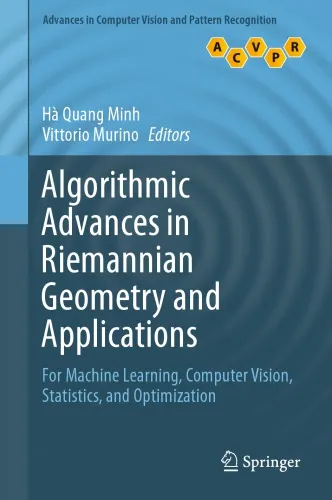
Algorithmic advances in Riemannian geometry and applications : for machine learning, computer vision, statistics, and optimization
Minh, Ha Quang;Murino, Vittorio
English
Beginner
Software Engineering
4.0 / 5
0 reviews
2016
Published
216
pages
197
views
Introduction to "Algorithmic Advances in Riemannian Geometry and Applications" "Algorithmic Advances in Riemannian Geometry and Applications" is an indispensable resource for researchers, practitioners, and enthusiasts working at the intersection of mathematics
Before you read
What will you get from this book?
Introduction to "Algorithmic Advances in Riemannian Geometry and Applications"
"Algorithmic Advances in Riemannian Geometry and Applications" is an indispensable resource for researchers, practitioners, and enthusiasts working at the intersection of mathematics, computer science, and engineering. The book delves into the algorithmic breakthroughs in Riemannian geometry and extends its practical applications to prominent fields such as machine learning, computer vision, statistics, and optimization. It serves as a bridge between theoretical advances and their implementation in real-world problems, empowering you to navigate high-dimensional curved spaces, model complex data, and streamline optimization algorithms.
At its core, Riemannian geometry is concerned with the differential-geometric study of curved spaces. This mathematical framework has emerged as a powerful tool for analyzing data and solving challenging problems in fields where traditional Euclidean methods fall short. Through this book, we bring together theoretical rigor, algorithmic innovation, and practical insights to demonstrate how Riemannian optimization and geometry-based methods can revolutionize diverse areas of computational science.
Whether you are a seasoned academic or a curious learner seeking a solid foundation, this text equips you with both the mathematical tools and the computational techniques to make progress in domains that demand innovative solutions and precision.
Detailed Summary of the Book
The book begins by laying the groundwork with an introduction to Riemannian geometry, discussing its core concepts, such as manifolds, geodesics, and curvature. We systematically explore how Riemannian spaces provide a more general framework for understanding and representing data that naturally resides in non-Euclidean domains. Each concept is supported by illustrative examples to help readers connect theory with practice.
Following the foundational chapters, we delve into algorithmic methodologies, including Riemannian optimization, gradient descent on manifolds, and related techniques. These chapters aim to show how the geometry of the data shapes optimization processes, ensuring better accuracy and convergence for various machine learning algorithms.
In the context of machine learning, the discussion moves to applications in kernel methods, deep learning on manifolds, and dimensionality reduction techniques. The book also highlights real-world applications in computer vision, such as shape analysis and 3D modeling, alongside statistical methods that harness Riemannian metrics to build robust statistical models.
The later sections focus on optimization problems over Riemannian spaces and their applications in diverse areas such as robotics, quantum mechanics, and signal processing. The final chapters provide extensive insights into future directions for algorithmic research in Riemannian geometry and its applications.
Key Takeaways
- Gain a deep understanding of mathematical principles underlying Riemannian geometry.
- Master algorithmic techniques tailored for Riemannian spaces, such as optimization and gradient descent on manifolds.
- Learn how to effectively apply Riemannian methods to machine learning, computer vision, and statistics.
- Explore real-world use cases that demonstrate the power of geometry-aware algorithms.
- Equip yourself with tools to tackle high-dimensional, non-Euclidean datasets in innovative ways.
Famous Quotes from the Book
"In a world modeled by non-Euclidean structures, Riemannian geometry is not just a choice—it is a necessity."
"The curvature of a space tells a story—it shapes how data interacts and how algorithms evolve."
"Understanding geometry is the gateway to understanding optimization in its fullest sense."
Why This Book Matters
Riemannian geometry has become a cornerstone for modern advancements in data analysis, machine learning, and optimization. In an era where information exists in complex and high-dimensional domains, traditional Euclidean frameworks are insufficient to tackle the diversity of challenges. This book stands out as a timely and comprehensive guide, filling this critical knowledge gap.
Researchers in computer vision, for instance, rely on Riemannian methods for applications such as face recognition and shape analysis, where data resides on curved manifolds. Machine learning practitioners benefit from the book's guidance in training algorithms for curved spaces, ultimately enhancing their performance and robustness. Statisticians can draw on the insights here to analyze data distributions and probabilities in non-Euclidean spaces.
What makes this book truly impactful is its commitment to blending theory with practice. By offering readers access to both mathematical foundations and implementation strategies, it democratizes the subject for a wide audience. Furthermore, the algorithms and insights provided within are essential for anyone seeking to innovate in the fields of AI, data science, or applied mathematics.
In conclusion, "Algorithmic Advances in Riemannian Geometry and Applications" is more than a textbook—it is a call to embrace a new paradigm of understanding and solving complex problems. It paves the way for scientific breakthroughs by equipping its readers with the tools and perspectives needed to harness the power of geometry.
Ask this book
Your question is answered in the context of this title and author. Each answer uses 2 points.
Sign in to ask the book assistant.
Reader reviews
0 reviews, 4.0 average out of 5
No reviews yet
If you have read this book, help the next reader with your experience.
Write a review
Sign in to publish a review.
Reader questions and answers
Ask a focused question and learn from the community.
Sign in to ask or answer a question.
No questions yet
Be the first to ask a clear, useful question.
What to read next
Related references that continue this learning path.


Modern Computer Vision with PyTorch: A Practical Roadmap From Deep Learning Fundamentals to Advanced Applications and Generative AI, 2nd Edition
V Kishore Ayyadevara,Yeshwanth Reddy
2023
View book