Fundamentals of Python: From First Programs through Data Structures
Kenneth A. Lambert
2009
View book
Book guide and evaluation
Wang, Jiande;Wu, Yonghui
0 reviews
Published
pages
views
Introduction to "Algorithm Design Practice for Collegiate Programming Contests and Education" "Algorithm Design Practice for Collegiate Programming Contests and Education" is a comprehensive and practical resource for anyone seeking mastery in algorithm design. This book i
Before you read
"Algorithm Design Practice for Collegiate Programming Contests and Education" is a comprehensive and practical resource for anyone seeking mastery in algorithm design. This book is meticulously crafted to cater to both aspiring competitive programmers and educators aiming to enhance their teaching methodology. With its methodical approach, plethora of examples, and emphasis on problem-solving, this book is invaluable for those preparing for prestigious programming contests or simply looking to deepen their understanding of algorithms.
The journey through this book unveils the fundamental principles of algorithm design and provides a rich set of exercises to hone your skills. Covering a diverse range of topics, it bridges the gap between theoretical concepts and practical applications. Readers will grow confident in tackling complex problems and navigating the world of competitive programming with precision and skill.
This book is divided into meticulously crafted chapters, each focusing on essential algorithmic techniques and problem-solving strategies. It begins with foundational topics such as basic data structures, greedy algorithms, and divide-and-conquer strategies. Gradually, it delves into advanced techniques, including dynamic programming, graph theory, computational geometry, and advanced mathematics for programming.
The unique appeal of this book lies in its problem-centric approach. Each concept is paired with an array of carefully chosen problems, ranging from beginner to advanced levels, enabling readers to reinforce their understanding. The explanations are exhaustive but concise, making complex ideas accessible without oversimplification. By embedding solutions alongside alternative problem-solving techniques, the book encourages creativity and adaptability—skills vital for success in programming contests.
Educationally, this book also emphasizes clarity and detailed reasoning, offering valuable insights into pedagogy for educators. Teachers and mentors can adopt these strategies to engage students, challenge their thinking, and inspire algorithmic innovation in the classroom.
What truly sets this book apart is its ability to deliver both theoretical depth and practical utility. Here are the key takeaways:
Throughout the book, the authors share profound insights that resonate with readers and push them to strive for excellence:
"Algorithm design isn't just about finding the solution; it's about understanding the problem and unlocking the possibilities it holds."
"In programming contests and in life, problems are rarely solved with brute force—they are solved with insight and creativity."
"The art of competitive programming lies in seeing patterns where others see chaos."
In a world increasingly driven by technology, the ability to solve problems programmatically is more critical than ever. For collegiate programmers aspiring to excel in competitions like ACM-ICPC, Google Code Jam, or Codeforces rounds, this book serves as an essential guide and arsenal for preparation.
Beyond contests, the book fosters a mindset. It teaches readers how to decompose complex problems, identify patterns, and arrive at solutions efficiently. These are skills that transcend programming, extending to fields such as engineering, research, and data science.
Educators, too, will find this book invaluable. Its structured approach and thoughtfully crafted examples make it an ideal textbook for algorithm design courses, as well as a go-to reference for creating challenging, instructive problems for students.
Ultimately, "Algorithm Design Practice for Collegiate Programming Contests and Education" is more than a book—it's a mentor, a coach, and the foundation upon which success in competitive programming and algorithmic thinking is built.
Your question is answered in the context of this title and author. Each answer uses 2 points.
0 reviews, 4.5 average out of 5
Sign in to publish a review.
Ask a focused question and learn from the community.
Related references that continue this learning path.
Kenneth A. Lambert
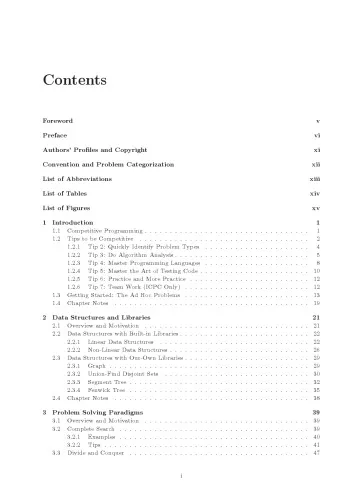
Steven Halim,Felix Halim,Suhendry Effendy