Book guide and evaluation
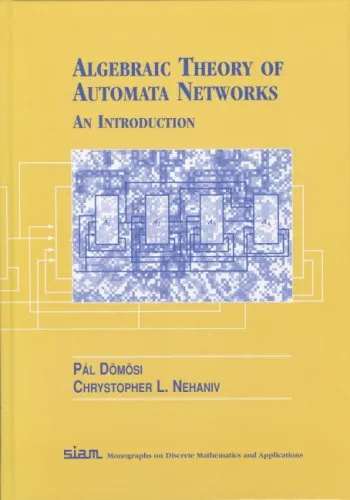
Algebraic Theory of Automata Networks: An Introduction (SIAM Monographs on Discrete Mathematics and Applications, 11)
Pal Domosi,Chrystopher L. Nehaniv
English
Beginner
Mathematics
4.4 / 5
0 reviews
2004
Published
268
pages
438
views
Introduction to Algebraic Theory of Automata Networks The "Algebraic Theory of Automata Networks: An Introduction" is a notable contribution to the domain of discrete mathematics and automata theory. This book unveils the intricate algebraic frameworks underpinning automata ne
Before you read
What will you get from this book?
Introduction to Algebraic Theory of Automata Networks
The "Algebraic Theory of Automata Networks: An Introduction" is a notable contribution to the domain of discrete mathematics and automata theory. This book unveils the intricate algebraic frameworks underpinning automata networks, providing a profound understanding that enhances both theoretical inquiry and practical application.
Detailed Summary of the Book
The book is an in-depth exploration of the algebraic structures that govern automata networks—an emerging and significant area in the study of complex systems. It draws on core concepts in algebra, network theory, and dynamics to provide a comprehensive theoretical foundation. By adopting a systematic approach, the authors guide readers through the methodological principles and mathematical tools necessary for analyzing automata networks.
Initially, the text introduces readers to fundamental concepts, including finite automata, semigroups, and group actions. The authors then delve into more complex topics such as synchronous and asynchronous automata networks, emphasizing their algebraic properties and implications. The exploration extends to the role of symmetry and topology in influencing the behavior and dynamics of these networks.
With meticulously crafted chapters, the book gradually builds from basic principles to expound on advanced topics like cascading automata, network reducibility, and the effects of network connectivity. Each chapter is replete with illustrative examples, formal definitions, and rigorous proofs, ensuring readers can consolidate their understanding while equipping them with the analytical skills to tackle real-world applications.
Key Takeaways
- A firm grasp of basic algebraic systems such as sets, functions, and relations, along with a deep understanding of finite automata and their networks.
- Insight into the dynamic properties of networks, including synchronization, stability, and emergence.
- Theoretical and practical applications such as modeling computational processes and simulating biological systems.
- New perspectives on how complex system properties can be explained through algebraic means.
- A substantial number of exercises that reinforce the concepts and encourage further investigation.
Famous Quotes from the Book
"In the realm of discrete mathematics, an automata network is not merely a collection of autonomous units, but rather a symphony of algebraic relations orchestrating system-wide coherence."
"As we delve into the algebraic theory, we uncover the hidden symmetries and intrinsic order that govern these fascinating networks."
Why This Book Matters
This book is pivotal for anyone interested in the crossroads of algebra and network theory, particularly those who engage with complex systems regularly. It elevates the understanding of automata networks from a mechanical perspective to one enriched with algebraic insights.
Furthermore, it is instrumental for researchers and practitioners in fields like computer science, systems biology, and artificial intelligence, where modeling, simulation, and analysis of network dynamics are paramount. The book bridges the gap between abstract mathematical theory and concrete applications, thereby expanding the potential for innovation in technology and science.
By offering a novel framework for exploring how complexity and structure emerge from simple automata configurations, it paves the way for groundbreaking research and application. It also seeks to motivate the development of new mathematical techniques and ideas that continue to advance this vital area of study.
Ask this book
Your question is answered in the context of this title and author. Each answer uses 2 points.
Sign in to ask the book assistant.
Reader reviews
0 reviews, 4.4 average out of 5
No reviews yet
If you have read this book, help the next reader with your experience.
Write a review
Sign in to publish a review.
Reader questions and answers
Ask a focused question and learn from the community.
Sign in to ask or answer a question.
No questions yet
Be the first to ask a clear, useful question.
What to read next
Related references that continue this learning path.