
Book guide and evaluation
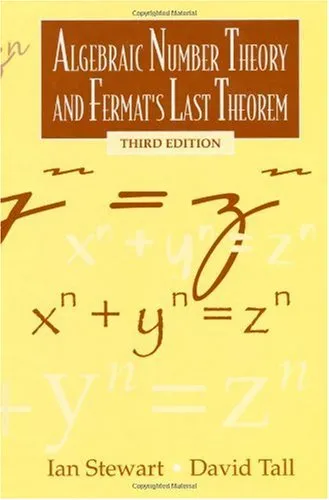
Algebraic Number Theory and Fermat's Last Theorem
Ian Stewart,David Tall
English
Beginner
Number Theory
4.5 / 5
0 reviews
2002
Published
334
pages
684
views
Introduction to 'Algebraic Number Theory and Fermat's Last Theorem' Welcome to a journey into the captivating world of algebra and number theory, as we explore the historic and intellectual depths of 'Algebraic Number Theory and Fermat's Last Theorem'. This book seamlessly
Before you read
What will you get from this book?
Introduction to 'Algebraic Number Theory and Fermat's Last Theorem'
Welcome to a journey into the captivating world of algebra and number theory, as we explore the historic and intellectual depths of 'Algebraic Number Theory and Fermat's Last Theorem'. This book seamlessly blends rigorous mathematical concepts with historical narratives, presenting a compelling exploration of one of the most famous problems in mathematics.
Detailed Summary of the Book
The book 'Algebraic Number Theory and Fermat's Last Theorem' takes the reader on an exciting intellectual adventure through the realm of algebraic number theory, an essential branch of mathematics that deals with the properties of numbers and the solutions to polynomial equations. This domain finds itself at the heart of one of the most enigmatic theorem puzzles: Fermat's Last Theorem.
Pierre de Fermat, a 17th-century French mathematician, posited what came to be known as Fermat's Last Theorem—a deceptively simple-looking problem that no three positive integers a, b, and c can satisfy the equation \\(a^n + b^n = c^n\\) for any integer value of n greater than two. The theorem challenged mathematicians for centuries until it was finally proven by Andrew Wiles in 1994.
This book meticulously details the journey leading to this monumental achievement, space navigation through key concepts of algebraic structures, field theory, and elliptic curves. By leveraging the rich historical tapestry and intricate mathematical details, 'Algebraic Number Theory and Fermat's Last Theorem' illuminates the steps and missteps, the conjectures and proofs, and the collaborative efforts that finally led to the resolution of what was once the most vexing conundrum in mathematics.
Key Takeaways
- Understanding the deep interconnections between algebraic number theory and Fermat's Last Theorem.
- An appreciation for the historical context and evolution of mathematical thought, particularly in number theory.
- Insight into the techniques and methods used by Andrew Wiles, including modular forms and elliptic curves.
- A recognition of the collaborative spirit and the cerebral tenacity required to solve complex mathematical problems.
Famous Quotes from the Book
"Unlock the mysteries of numbers, and you unlock the mysteries of the universe."
"In the heart of every significant mathematical problem lies a splash of audacious curiosity."
Why This Book Matters
This book is not only an exploration into a significant mathematical breakthrough but also a testament to human perseverance and intellectual curiosity. It stands out as a crucial resource for both students and professionals interested in the intricate dance between numbers and the abstract realms of algebra. By delving into the history and proofs associated with Fermat's Last Theorem, the readers gain a comprehensive view of how mathematics evolves and the critical role of collaboration and creativity in scientific discovery.
Furthermore, 'Algebraic Number Theory and Fermat's Last Theorem' opens the door for those curious minds who wish to engage deeply with mathematics, providing a robust framework for understanding the concepts driving this complex and beautiful subject. It is a profound reminder of how human intellect can untangle the seemingly unsolvable puzzles, lending itself as a bridge to future discoveries and inspiring generations of mathematicians to come.
In conclusion, this book is not merely a mathematical treatise; it is a celebration of the relentless pursuit of knowledge and an invaluable contribution to the library of those who seek to understand and expand the boundaries of human thought.
Ask this book
Your question is answered in the context of this title and author. Each answer uses 2 points.
Sign in to ask the book assistant.
Reader reviews
0 reviews, 4.5 average out of 5
No reviews yet
If you have read this book, help the next reader with your experience.
Write a review
Sign in to publish a review.
Reader questions and answers
Ask a focused question and learn from the community.
Sign in to ask or answer a question.
No questions yet
Be the first to ask a clear, useful question.
What to read next
Related references that continue this learning path.
A Classical Introduction to Modern Number Theory
Kenneth Ireland,Michael Rosen (auth.)
1982
View book