
Book guide and evaluation
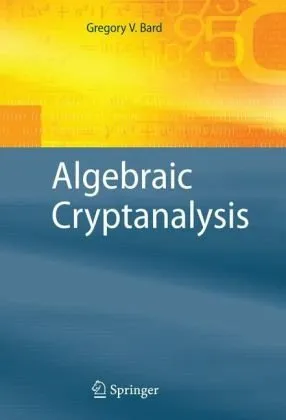
Algebraic Cryptanalysis
Gregory V. Bard (auth.)
English
Beginner
Software Engineering
4.6 / 5
0 reviews
2009
Published
368
pages
172
views
Introduction to "Algebraic Cryptanalysis" "Algebraic Cryptanalysis" is a comprehensive and in-depth exploration of the transformative role algebraic methods play in the realm of cryptography. Authored by Gregory V. Bard, this book meticulously examines how algorithms roo
Before you read
What will you get from this book?
Introduction to "Algebraic Cryptanalysis"
"Algebraic Cryptanalysis" is a comprehensive and in-depth exploration of the transformative role algebraic methods play in the realm of cryptography. Authored by Gregory V. Bard, this book meticulously examines how algorithms rooted in algebra are used to analyze, understand, and ultimately break cryptographic systems. The book is a bridge between theoretical mathematics and practical cryptographic applications, making it an ideal resource for researchers, educators, students, and professionals in computer science, mathematics, and information security.
With its unique focus on algebraic techniques and their applications to cryptography, the book serves as both a foundational guide for newcomers to the field and an advanced resource for seasoned professionals. By blending theoretical insights with practical implementations, it offers a balanced and nuanced perspective on a complex and ever-evolving discipline.
This introductory volume provides readers with the knowledge required to perform algebraic cryptanalysis while emphasizing the importance of responsible use in light of the ethical challenges posed by such techniques.
Detailed Summary of the Book
"Algebraic Cryptanalysis" is structured around the interplay between cryptographic algorithms and algebraic methods, aiming to demystify how algebra reveals vulnerabilities in encryption systems.
The book begins by establishing fundamental concepts, including the algebraic notation and polynomial systems commonly encountered in cryptography, as well as the frameworks of various encryption schemes. Building on these basics, the text progresses to advanced topics, such as Gröbner bases, linearization methods, and solving systems of polynomial equations. Each of these is carefully explained in a mathematically rigorous yet accessible way.
One of the unique strengths of the book is its use of real-world cryptographic systems as case studies, including AES, DES, and RSA as well as several stream ciphers. This hands-on approach ensures that readers understand how the theory translates into practical cryptanalytic attacks. Furthermore, the book explores the efficiency of these attacks, weighing their computational feasibility and mathematical elegance.
In addition, an entire section of the book is devoted to hardware and software implementations of algebraic cryptanalytic methods, bridging the gap between conceptual techniques and real-world applications. The book also emphasizes the ethical responsibilities inherent in analyzing cryptographic systems, thus fostering a mature and responsible approach to security research.
Key Takeaways
- A thorough understanding of algebraic concepts and their applications to cryptanalysis.
- Detailed introductions to Gröbner bases, linearization techniques, and polynomial-solving algorithms.
- Case studies of real-world cryptographic attacks on encryption methods like AES, DES, and RSA.
- Balancing theoretical insights with practical tools and techniques for cryptanalysis.
- Insights into the ethical and legal responsibilities of researchers within the field of cryptography.
Famous Quotes from the Book
“Cryptographic systems are designed to safeguard secrets, but algebra often proves to be their undoing.”
“The elegance of algebra lies not only in its precision but also in its power to dismantle what was thought to be unbreakable.”
“With great mathematical power comes the ethical responsibility to use that power wisely.”
Why This Book Matters
"Algebraic Cryptanalysis" stands out because it sheds light on one of the most advanced and intriguing approaches to breaking cryptographic systems. In an age where encryption is a cornerstone of our digital society, understanding its vulnerabilities is essential—not to exploit them, but to strengthen the systems that protect us.
Through careful explanations and real-world examples, the book empowers readers to grasp the profound interplay between mathematics and security. It addresses not only the "how" but also the "why" of these techniques, ensuring a deep, practical, and ethical understanding of the material.
Moreover, this book pushes the frontier of cryptanalysis, inspiring researchers to develop more robust cryptographic designs capable of withstanding algebraic attacks. For educators, it serves as a vital teaching resource; for students, it’s an indispensable learning tool; and for professionals, it offers actionable insights into an essential aspect of modern cryptography.
In a rapidly evolving digital landscape, "Algebraic Cryptanalysis" remains a critical contribution to the fields of both mathematics and computer security, providing the tools and knowledge needed to navigate the complexities of encryption and decryption.
Ask this book
Your question is answered in the context of this title and author. Each answer uses 2 points.
Sign in to ask the book assistant.
Reader reviews
0 reviews, 4.6 average out of 5
No reviews yet
If you have read this book, help the next reader with your experience.
Write a review
Sign in to publish a review.
Reader questions and answers
Ask a focused question and learn from the community.
Sign in to ask or answer a question.
No questions yet
Be the first to ask a clear, useful question.
What to read next
Related references that continue this learning path.

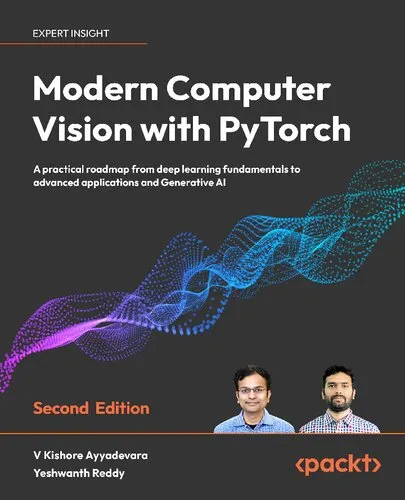
Modern Computer Vision with PyTorch: A Practical Roadmap From Deep Learning Fundamentals to Advanced Applications and Generative AI, 2nd Edition
V Kishore Ayyadevara,Yeshwanth Reddy
2023
View book