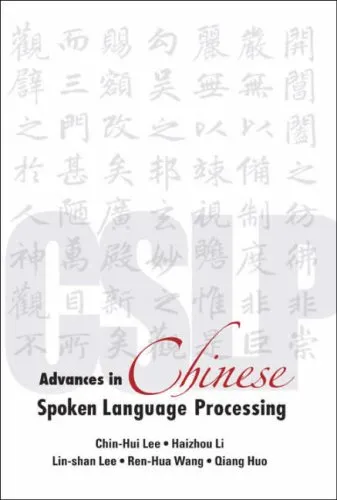
Introduction to "Advances in Chinese Spoken Language Processing"
The book "Advances in Chinese Spoken Language Processing", authored by Chin-hue Lee, Haizhou Li, Lin-shan Lee, Ren-hua Wang, and Qiang Huo, is an insightful resource for researchers, linguists, engineers, and enthusiasts delving into the advances and challenges in Chinese spoken language technology. Covering a wide range of topics, this book encapsulates decades of research and innovation in processing one of the world's most complex and widely spoken languages. Fusing linguistics, computer science, and artificial intelligence, this work serves as a unique guide to understanding the nuances of Chinese language processing in the context of speech recognition, synthesis, and language modeling.
Detailed Summary of the Book
Chinese spoken language processing presents a set of unique challenges due to the tonal nature of the language, lack of word boundaries, linguistic variations, and complexities in pronunciation. This book offers a holistic exploration of these difficulties and provides innovative solutions supported by cutting-edge technologies. It delves deeply into fundamental concepts such as tonal modeling, prosody analysis, and the application of neural networks in speech recognition and synthesis.
The content is divided into key areas, covering speech recognition systems tailored for Mandarin, Cantonese, and other Chinese dialects. It also highlights advancements in text-to-speech synthesis, especially in preserving tonal integrity and naturalness. Meanwhile, readers are introduced to innovations in language modeling, enabling better understanding and context-based processing of spoken Chinese.
What makes this book stand out is its focus on real-world applications, including voice-activated devices, educational tools, and human-computer interaction systems that cater specifically to Chinese users. The authors expertly bridge the gap between theoretical foundations and practical implementations, making this book highly valuable for academic study and industrial applications alike.
Key Takeaways
- Understanding the unique linguistic challenges in Chinese spoken language processing, including tonal variations and the absence of word delimiters.
- Comprehensive insights into modern speech recognition technologies, with a focus on solutions for Mandarin and other Chinese dialects.
- An in-depth review of text-to-speech synthesis techniques for Chinese, emphasizing tonal accuracy and natural speech generation.
- Detailed exploration of machine learning, deep learning, and neural network applications in processing Chinese speech and text.
- Practical case studies and real-world applications showcasing the state-of-the-art in Chinese language technologies.
- Emerging trends in the field, such as conversational AI, voice biometrics, and AI-driven content generation in Chinese.
Famous Quotes from the Book
Throughout the book, the authors encapsulate profound ideas that resonate with the challenges and possibilities in Chinese spoken language processing. Here are a few notable quotes:
"The key to understanding spoken Chinese lies not only in recognizing phonemes but also in capturing the rhythmic and tonal essence that brings the language to life."
"Advances in machine learning may allow us to bridge the gap between human-like intuition and computational precision in Chinese spoken language processing."
"Languages evolve, and so must our technologies. In tackling the challenges of Chinese speech, we lay the groundwork for the future of multilingual processing systems worldwide."
Why This Book Matters
"Advances in Chinese Spoken Language Processing" is not just another textbook—it is a cornerstone in the field of computational linguistics and speech technology. Chinese, being one of the most widely spoken languages globally, has posed significant challenges to linguists and computer scientists due to its unique phonetic and structural properties. This book is a groundbreaking effort to address these challenges systematically, offering both foundational knowledge and practical implementations.
For researchers, this book provides a roadmap to understanding the nuances of Chinese language technology. For industry professionals, it offers the tools and methods necessary to build robust speech-enabled applications for a vast and diverse user base. Given the rapid evolution of artificial intelligence and natural language processing, the concepts outlined in this book remain relevant for advancing AI-based systems with global multilingual support.
Most importantly, this book serves as inspiration for future research and development. By documenting progress and sharing insights, the authors have not only contributed to the field but have also invited future innovators to build upon these advancements.
A must-read for anyone passionate about linguistics, artificial intelligence, and the frontier of human-computer interaction.