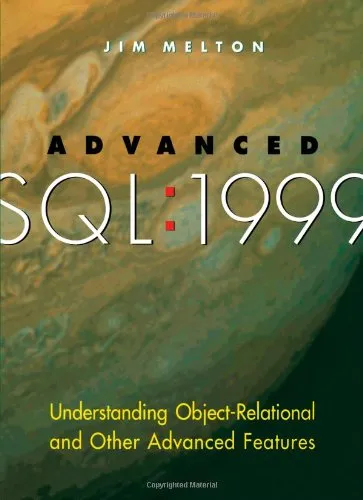
Book guide and evaluation
Advanced SQL: 1999 - Understanding Object-Relational and Other Advanced Features (The Morgan Kaufmann Series in Data Management Systems)
Jim Melton
English
Unordered
SQL
4.5 / 5
0 reviews
2002
Published
564
pages
305
views
Advanced SQL: 1999 - Understanding Object-Relational and Other Advanced Features (The Morgan Kaufmann Series in Data Management Systems) object-relational database design, SQL:1999 standard In-depth exploration of Advanced SQL: 1999 and its object-relational features fo
Before you read
What will you get from this book?
Analytical Summary
The book Advanced SQL: 1999 - Understanding Object-Relational and Other Advanced Features (The Morgan Kaufmann Series in Data Management Systems) is a meticulous and authoritative guide that demystifies the SQL:1999 standard — a milestone in the evolution of structured query language. Authored with a precision that reflects decades of experience, this work provides both theoretical depth and practical clarity on how SQL developed into an object-relational powerhouse.
SQL:1999 represents a significant expansion of the traditional relational model, incorporating advanced constructs that allow for complex data types, user-defined types, and object-oriented principles. This book breaks down each component of the standard and examines its implications for modern database design and usage.
By weaving together formal explanations, real-world examples, and comparative analysis, the text equips readers to understand how and why these advanced features were integrated. It offers a unique blend of conceptual rigor and applied insight, making it an invaluable reference for software engineers, database architects, and academic researchers.
Key Takeaways
This book delivers an unparalleled survey of object-relational capabilities in SQL:1999, enabling readers to bridge gaps between relational theory and contemporary practice.
Readers will grasp the motivations behind standard revisions, the syntax and semantics of complex SQL features, and how these impact database interoperability. The emphasis on standards ensures that concepts learned can be applied across systems adhering to SQL:1999 compliance.
Secondary keywords like “object-relational database design” and “SQL:1999 standard” are illuminated through in-depth discussions on type systems, procedural extensions, triggers, recursive queries, and schema evolution.
Memorable Quotes
“A standard is only as strong as its ability to evolve without losing its core principles.” Unknown
“Object-relational features empower database designers to think beyond fixed schemas.” Unknown
“SQL:1999 bridges the relational and object-oriented paradigms in ways that benefit long-term data integrity.” Unknown
Why This Book Matters
In the fast-evolving world of data management, mastering complex standards like SQL:1999 is both a challenge and an opportunity.
This work stands out because it does more than present syntax; it contextualizes advancements in terms of industry needs and design philosophies. For the professional eager to build robust, scalable, and standards-compliant systems, or the academic pursuing database theory research, understanding the object-relational aspects of SQL:1999 is essential.
Information on awards or publication year is unavailable, as no reliable public source confirms these details. However, its lasting presence on recommended reading lists for computer science and data systems programs underlines its influence.
Inspiring Conclusion
If you are serious about understanding the intricate details of contemporary database design, Advanced SQL: 1999 - Understanding Object-Relational and Other Advanced Features (The Morgan Kaufmann Series in Data Management Systems) should be on your desk and in your daily lexicon.
With expert guidance on the SQL:1999 standard and object-relational database design, the book not only informs but inspires. It encourages readers to think critically about how database standards evolve and how to apply them to create systems that are both innovative and reliable.
Your next step is clear: engage with this book’s content, apply its concepts, discuss them with peers, and share insights within your professional community. In doing so, you help advance the collective understanding of data management in the object-relational era.
Ask this book
Your question is answered in the context of this title and author. Each answer uses 2 points.
Sign in to ask the book assistant.
Reader reviews
0 reviews, 4.5 average out of 5
No reviews yet
If you have read this book, help the next reader with your experience.
Write a review
Sign in to publish a review.
Reader questions and answers
Ask a focused question and learn from the community.
Sign in to ask or answer a question.
No questions yet
Be the first to ask a clear, useful question.
What to read next
Related references that continue this learning path.