Book guide and evaluation
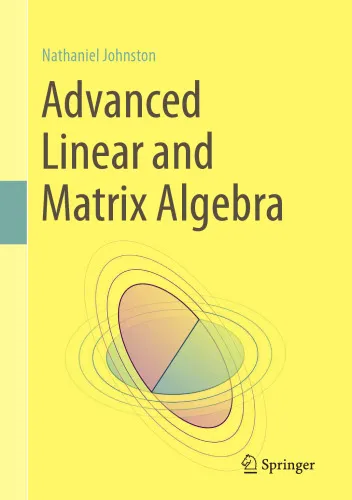
Advanced Linear and Matrix Algebra
Nathaniel Johnston (auth.)
English
Unordered
Mathematics
4.5 / 5
0 reviews
2021
Published
0 / XVI, 494
pages
115
views
This textbook emphasizes the interplay between algebra and geometry to motivate the study of advanced linear algebra techniques. Matrices and linear transformations are presented as two sides of the same coin, with their connection motivating inquiry throughout the book. Building
Before you read
What will you get from this book?
This textbook emphasizes the interplay between algebra and geometry to motivate the study of advanced linear algebra techniques. Matrices and linear transformations are presented as two sides of the same coin, with their connection motivating inquiry throughout the book. Building on a first course in linear algebra, this book offers readers a deeper understanding of abstract structures, matrix decompositions, multilinearity, and tensors. Concepts draw on concrete examples throughout, offering accessible pathways to advanced techniques. Beginning with a study of vector spaces that includes coordinates, isomorphisms, orthogonality, and projections, the book goes on to focus on matrix decompositions. Numerous decompositions are explored, including the Shur, spectral, singular value, and Jordan decompositions. In each case, the author ties the new technique back to familiar ones, to create a coherent set of tools. Tensors and multilinearity complete the book, with a study of the Kronecker product, multilinear transformations, and tensor products. Throughout, “Extra Topic” sections augment the core content with a wide range of ideas and applications, from the QR and Cholesky decompositions, to matrix-valued linear maps and semidefinite programming. Exercises of all levels accompany each section. Advanced Linear and Matrix Algebra offers students of mathematics, data analysis, and beyond the essential tools and concepts needed for further study. The engaging color presentation and frequent marginal notes showcase the author’s visual approach. A first course in proof-based linear algebra is assumed. An ideal preparation can be found in the author’s companion volume, Introduction to Linear and Matrix Algebra.
Ask this book
Your question is answered in the context of this title and author. Each answer uses 2 points.
Sign in to ask the book assistant.
Reader reviews
0 reviews, 4.5 average out of 5
No reviews yet
If you have read this book, help the next reader with your experience.
Write a review
Sign in to publish a review.
Reader questions and answers
Ask a focused question and learn from the community.
Sign in to ask or answer a question.
No questions yet
Be the first to ask a clear, useful question.
What to read next
Related references that continue this learning path.
The Feynman lectures on physics. Volume I, Mainly mechanics, radiation and heat
Feynman, Richard Phillips;Sands, Matthew Linzee;Leighton, Robert B.
2013
View book