Book guide and evaluation
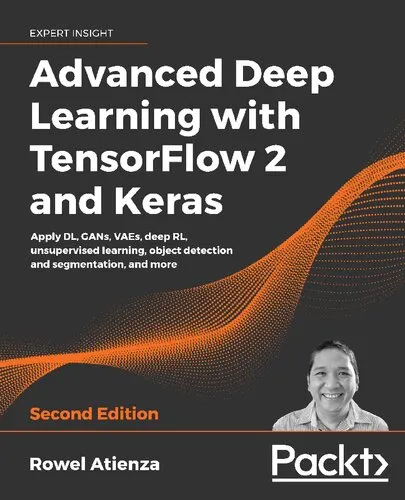
Advanced Deep Learning with TensorFlow 2 and Keras: Apply DL, GANs, VAEs, deep RL, unsupervised learning, object detection and segmentation, and more, 2nd Edition
Rowel Atienza
English
Beginner
Machine Learning
4.4 / 5
0 reviews
2020
Published
513
pages
1533
views
Updated and revised second edition of the bestselling guide to advanced deep learning with TensorFlow 2 and Keras Key Features Explore the most advanced deep learning techniques that drive modern AI results New coverage of unsupervised deep learning using mutual information, obj
Before you read
What will you get from this book?
Updated and revised second edition of the bestselling guide to advanced deep learning with TensorFlow 2 and Keras Key Features Explore the most advanced deep learning techniques that drive modern AI results New coverage of unsupervised deep learning using mutual information, object detection, and semantic segmentation Completely updated for TensorFlow 2.xBook Description Advanced Deep Learning with TensorFlow 2 and Keras, Second Edition is a completely updated edition of the bestselling guide to the advanced deep learning techniques available today. Revised for TensorFlow 2.x, this edition introduces you to the practical side of deep learning with new chapters on unsupervised learning using mutual information, object detection (SSD), and semantic segmentation (FCN and PSPNet), further allowing you to create your own cutting-edge AI projects. Using Keras as an open-source deep learning library, the book features hands-on projects that show you how to create more effective AI with the most up-to-date techniques. Starting with an overview of multi-layer perceptrons (MLPs), convolutional neural networks (CNNs), and recurrent neural networks (RNNs), the book then introduces more cutting-edge techniques as you explore deep neural network architectures, including ResNet and DenseNet, and how to create autoencoders. You will then learn about GANs, and how they can unlock new levels of AI performance. Next, you'll discover how a variational autoencoder (VAE) is implemented, and how GANs and VAEs have the generative power to synthesize data that can be extremely convincing to humans. You'll also learn to implement DRL such as Deep Q-Learning and Policy Gradient Methods, which are critical to many modern results in AI. What you will learn Use mutual information maximization techniques to perform unsupervised learning Use segmentation to identify the pixel-wise class of each object in an image Identify both the bounding box and class of objects in an image using object detection Learn the building blocks for advanced techniques - MLPss, CNN, and RNNs Understand deep neural networks - including ResNet and DenseNet Understand and build autoregressive models – autoencoders, VAEs, and GANs Discover and implement deep reinforcement learning methodsWho this book is for This is not an introductory book, so fluency with Python is required. The reader should also be familiar with some machine learning approaches, and practical experience with DL will also be helpful. Knowledge of Keras or TensorFlow 2.0 is not required but is recommended.Table of Contents Introducing Advanced Deep Learning with Keras Deep Neural Networks Autoencoders Generative Adversarial Networks (GANs) Improved GANs Disentangled Representation GANs Cross-Domain GANs Variational Autoencoders (VAEs) Deep Reinforcement Learning Policy Gradient Methods Object Detection Semantic Segmentation Unsupervised Learning Using Mutual Information
Ask this book
Your question is answered in the context of this title and author. Each answer uses 2 points.
Sign in to ask the book assistant.
Reader reviews
0 reviews, 4.4 average out of 5
No reviews yet
If you have read this book, help the next reader with your experience.
Write a review
Sign in to publish a review.
Reader questions and answers
Ask a focused question and learn from the community.
Sign in to ask or answer a question.
No questions yet
Be the first to ask a clear, useful question.
What to read next
Related references that continue this learning path.
Feature Engineering for Machine Learning: Principles and Techniques for Data Scientists
Alice Zheng,Amanda Casari
2018
View book