
Book guide and evaluation
Administrative Theory & Praxis
Vickers, Margaret H.
English
Unordered
Strategic Management
4.6 / 5
0 reviews
2006 July
Published
347
pages
177
views
Administrative Theory & Praxispp.69—88 Public administration scholarship, Organizational governance principles Explore Administrative Theory & Praxispp.69—88 for deep insights into governance and public administration frameworks. Analytical Summary The section of
Before you read
What will you get from this book?
Analytical Summary
The section of Administrative Theory & Praxis spanning pages 69—88 offers a concentrated exploration of the intellectual and practical underpinnings of modern administrative thought. This portion engages with some of the most persistent challenges in public administration, including the tension between theoretical ideals and field realities. Serious readers, academics, and professionals encounter an authoritative yet accessible synthesis, making it a rich reference for unpacking administrative frameworks in governance contexts.
By examining foundational ideas alongside incremental developments in administrative practice, this segment creates a bridge between abstract models and applied strategies. Whether you are a scholar seeking rigorous analysis or a practitioner navigating complex organizational landscapes, the contained discussions serve as both a critical review and a potential blueprint for informed decision-making. The focus on organizational governance principles and public administration scholarship is particularly compelling for those interested in policy implementation and institutional evolution.
Throughout these pages, the narrative navigates conceptual terrain—assessing historical trajectories, theoretical constructs, and emerging paradigms. It emphasizes the interdisciplinary nature of administrative theory, drawing connections across political science, management studies, and sociological perspectives. Although the exact publication year for this edition is information unavailable due to no reliable public source, the thematic relevance remains timeless, ensuring applicability across sectors and jurisdictions.
Key Takeaways
Readers of Administrative Theory & Praxispp.69—88 will leave with a nuanced grasp of the frameworks that guide administrative systems and an appreciation for the dynamic interplay between theory and praxis.
One critical takeaway is the importance of aligning theoretical models with practical realities, ensuring that policy and management strategies are both visionary and implementable.
The segment underscores the role of ethical considerations in policy-making, reminding administrators that governance must serve both institutional effectiveness and the public good.
Another insight revolves around adaptability: the capacity for administrative structures to evolve in response to shifting socio-political environments and emerging service delivery challenges.
Finally, readers are encouraged to view administrative theory not as static doctrine but as a living set of principles subject to ongoing refinement through research, critique, and practice.
Memorable Quotes
“In administration, the clarity of purpose is matched only by the flexibility of method.” Unknown
“Governance succeeds when theory guides action, and action refines theory.” Unknown
“Public administration is both a science of structure and an art of service.” Unknown
Why This Book Matters
The relevance of Administrative Theory & Praxispp.69—88 lies in its ability to position administrative concepts within actionable contexts, making it indispensable to scholars and practitioners alike.
This segment provides the intellectual scaffolding necessary for understanding organizational governance principles in a way that harmonizes structural integrity with adaptive management.
By engaging the reader in critical analysis and by prompting reflection on established norms, it catalyzes improved methodologies and strategic innovation in public administration scholarship.
Inspiring Conclusion
In an era where governance and public service face unprecedented complexity, revisiting Administrative Theory & Praxispp.69—88 invites us to recalibrate our understanding of administrative frameworks and their practical implications.
The continuity between conceptual rigor and operational finesse demonstrated in these pages serves as a reminder that administrators, academics, and engaged citizens alike can contribute to the evolution of responsive and accountable institutions. By engaging deeply with these ideas, you position yourself to not only comprehend but to actively shape the discourse on effective governance.
Take the next step: read, share, and discuss this work within your circles, fostering dialogues that bridge academic inquiry and field experience for lasting impact.
Ask this book
Your question is answered in the context of this title and author. Each answer uses 2 points.
Sign in to ask the book assistant.
Reader reviews
0 reviews, 4.6 average out of 5
No reviews yet
If you have read this book, help the next reader with your experience.
Write a review
Sign in to publish a review.
Reader questions and answers
Ask a focused question and learn from the community.
Sign in to ask or answer a question.
No questions yet
Be the first to ask a clear, useful question.
What to read next
Related references that continue this learning path.
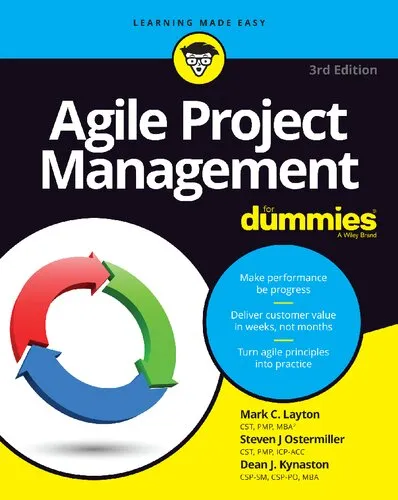
Agile Project Management For Dummies
Mark C. Layton,Steven J Ostermiller,Dean J. Kynaston
2020
View book