A Comprehensive Introduction to Differential Geometry, Vol. 1, 3rd Edition
Michael Spivak
1999
View book
Book guide and evaluation
Basil Gordon (auth.),Basil Gordon (eds.)
0 reviews
Published
pages
views
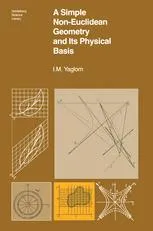
Welcome to the fascinating exploration of non-Euclidean geometry and its profound relevance to modern physics, as captured in "A Simple Non-Euclidean Geometry and Its Physical Basis: An Elementary Account of Galilean Geometry and the Galilean Principle of Relativity". This book o
Before you read
Welcome to the fascinating exploration of non-Euclidean geometry and its profound relevance to modern physics, as captured in "A Simple Non-Euclidean Geometry and Its Physical Basis: An Elementary Account of Galilean Geometry and the Galilean Principle of Relativity". This book offers an accessible yet comprehensive introduction to the fundamentals of Galilean geometry and its pivotal role in the development of the principle of relativity.
The book delves into the essence of non-Euclidean geometries with a focus on the Galilean geometry which, unlike the more commonly discussed hyperbolic and elliptic geometries, directly correlates with physical principles observed in our universe. The narrative begins by establishing a solid foundation in classical Euclidean geometry, allowing readers to appreciate the historical context and the paradigm shift that non-Euclidean concepts brought about.
Progressing from the basics, the text introduces the core principles of Galilean geometry, emphasizing its axiomatic foundations and inherent differences from Euclidean and Riemannian geometries. The author, Basil Gordon, systematically outlines how these differences not only provide a simpler geometric framework but also relate intimately to the physical phenomena described by the Galilean principle of relativity.
A significant portion of the book is dedicated to elucidating the relationship between geometry and physics, demonstrating how Galilean geometry forms a geometric backdrop for the classical mechanics articulated by Galileo and Newton. The text also lays the groundwork for understanding Einstein's later developments in relativistic physics, offering readers a bridge between classical and modern theoretical physics.
"Geometry, that paradigm of intellectual pursuit, finds its profoundest application in describing the physical universe in which we reside."
"The elegance of Galilean geometry lies not in its complexity, but in its unwavering correspondence to the fundamental truths of motion and relativity."
"To view the world through the lens of Galilean principles is to embrace a simpler universe governed by discernible laws."
In an era dominated by rapid scientific advancement, understanding the foundational principles that underpin contemporary physics is more critical than ever. "A Simple Non-Euclidean Geometry and Its Physical Basis" offers a crucial perspective by reverting to the basics of geometry and demonstrating their relevance in the evolution of physical theories.
Through its elementary and approachable exposition, the book invites students, educators, and enthusiasts of mathematics and physics to grasp the significance of geometric principles in the broader context of scientific discovery. It serves as a reminder of the beauty and necessity of fundamental scientific inquiry.
Moreover, this book is a significant educational resource that helps bridge the gap between classical theories and modern physics, making it an invaluable asset for anyone looking to deepen their understanding of how geometry shapes our comprehension of the universe.
Your question is answered in the context of this title and author. Each answer uses 2 points.
0 reviews, 4.5 average out of 5
Sign in to publish a review.
Ask a focused question and learn from the community.
Related references that continue this learning path.
Michael Spivak
Svetlana Cojocaru,Svetlana Cojocaru,Gerhard Pfister,Victor Ufnarovski