

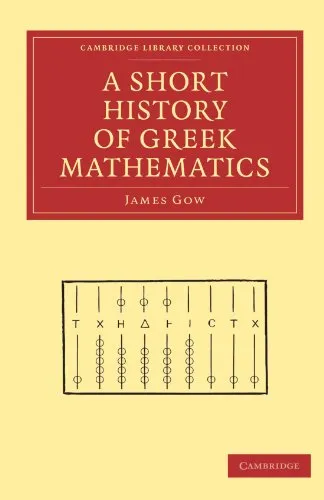
Book guide and evaluation
A Short History of Greek Mathematics
James Gow
English
Beginner
Mathematics
4.0 / 5
0 reviews
2010
Published
344
pages
142
views
Introduction Welcome to the rich and fascinating world of ancient Greek mathematics! "A Short History of Greek Mathematics" by James Gow offers readers a deep dive into this thriving intellectual tradition that laid the foundation for modern mathematical thought. T
Before you read
What will you get from this book?
Introduction
Welcome to the rich and fascinating world of ancient Greek mathematics! "A Short History of Greek Mathematics" by James Gow offers readers a deep dive into this thriving intellectual tradition that laid the foundation for modern mathematical thought. This work is not just a history of numbers or equations but a testament to the brilliance and creativity of Greek mathematicians who used their genius to unveil universal truths. Meticulously researched and thoughtfully presented, this book is an essential resource for anyone intrigued by the origins and evolution of mathematical knowledge.
Ancient Greece was a cradle of innovation, producing groundbreaking ideas in philosophy, art, and science. Mathematics was no exception. In this book, we journey through the lives and works of renowned mathematicians such as Euclid, Pythagoras, Archimedes, and many others who defied the limits of knowledge during their time. My purpose in writing this book was not only to document the significant developments in Greek mathematics but also to showcase their enduring relevance in our modern world. By tracing this progression, we connect history with the logical rigor and empirical precision that form the basis of mathematics today.
Detailed Summary of the Book
"A Short History of Greek Mathematics" is a compact yet rich exposition of the mathematical discoveries that emerged in the ancient Greek world. The book is divided into sections that follow a chronological path. I begin with the earliest Greek approaches to numbers and geometrical shapes, delving into the mythical and philosophical underpinnings of their ideas. From here, we proceed to the systematic and practical advancements that occurred over centuries.
Key topics include the development of number theory, geometry, and early explorations of calculus-like methods. Significant attention is given to the Pythagorean school and their mystical yet groundbreaking efforts to understand numbers as the essence of reality. Euclid’s "Elements," one of the most influential books in mathematical history, is explored in detail. Similarly, the works of Archimedes and his astonishing contributions to mechanics and approximation methods reflect a genius far ahead of its time.
Each chapter highlights not only the mathematical achievements but also the cultural and philosophical context that shaped the discipline. Greek mathematics is shown to be more than an abstract science; it is presented as a living, breathing pursuit intertwined with the intellectual currents of the era.
Key Takeaways
- Greek mathematics prioritized deductive reasoning and logical proofs, which form the foundation of modern mathematics.
- The works of Greek mathematicians like Euclid and Archimedes are still studied and admired for their ingenuity and applicability.
- Greek thinkers approached mathematics not only as a practical tool but also as a philosophical inquiry into the nature of the universe.
- Understanding the history of Greek mathematics provides valuable insights into the origins of mathematical concepts used today.
Famous Quotes from the Book
"The Greeks were not the inventors of mathematics, but they were the first to apply rigorous logic to its study, transforming it into an intellectual discipline." – James Gow
"Euclid's geometry is not merely a scientific manual; it is a poetic vision of order and beauty, cast into the disciplined form of logical deduction." – James Gow
"Archimedes’ methods were so advanced that they can only be regarded as the precursor to modern calculus, centuries ahead of Newton and Leibniz." – James Gow
Why This Book Matters
The relevance of "A Short History of Greek Mathematics" lies in its ability to bridge the gap between ancient scholarly pursuits and contemporary understanding. By exploring how mathematics evolved in ancient Greece, we gain a deeper appreciation for the discipline’s timeless nature and its power to transcend cultural and temporal boundaries.
This book serves as more than just a historical account; it is a study of how intellectual curiosity and logical rigor can produce ideas that last for millennia. Its insights resonate not only with mathematicians and historians but with anyone interested in the human journey of discovery. If we wish to understand the roots of modern knowledge, we must look to ancient Greece, where mathematical thought first flourished and was cherished.
By illuminating these transformative achievements, this book underscores the importance of mathematics as a cornerstone of human progress. I hope it serves as a source of awe and inspiration to readers, reminding them of the incredible legacy bequeathed to us by the Greek mathematicians.
Ask this book
Your question is answered in the context of this title and author. Each answer uses 2 points.
Sign in to ask the book assistant.
Reader reviews
0 reviews, 4.0 average out of 5
No reviews yet
If you have read this book, help the next reader with your experience.
Write a review
Sign in to publish a review.
Reader questions and answers
Ask a focused question and learn from the community.
Sign in to ask or answer a question.
No questions yet
Be the first to ask a clear, useful question.
What to read next
Related references that continue this learning path.



Modern Computer Vision with PyTorch: A Practical Roadmap From Deep Learning Fundamentals to Advanced Applications and Generative AI, 2nd Edition
V Kishore Ayyadevara,Yeshwanth Reddy
2023
View book