
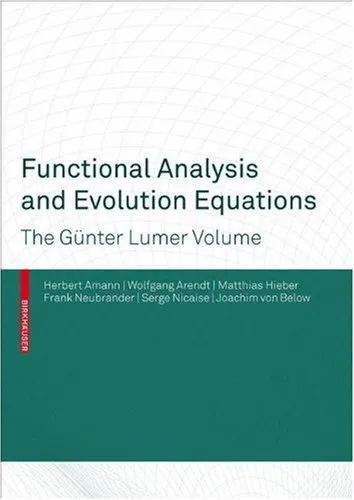
Functional analysis and evolution equations: The Gunter Lumer volume
Herbert Amann,Wolfgang Arendt,Matthias Hieber,Frank Neubrander,Serge Nicaise,Joachim Below
2008
View book

Book guide and evaluation
W. W. Rouse Ball
0 reviews
Published
pages
views
Introduction to A Short Account of the History of Mathematics Written by the mathematician and historian W. W. Rouse Ball, A Short Account of the History of Mathematics is one of the most celebrated works that encapsulates the profound evolution of mathematical thought thr
Before you read
Written by the mathematician and historian W. W. Rouse Ball, A Short Account of the History of Mathematics is one of the most celebrated works that encapsulates the profound evolution of mathematical thought throughout history. This timeless masterpiece provides readers with a systematic and insightful overview of the development of mathematics, from its ancient origins right up to the 19th century. With its clarity and depth, the book offers an engaging journey through the lives and works of numerous mathematicians whose contributions have shaped the discipline over centuries. Whether you're a student, a historian, or an enthusiast of mathematics, this book serves as an essential resource for better understanding the field and its historical context.
Rouse Ball's work takes the reader on a chronological journey through the history of mathematics, providing a rich exploration of its roots and evolution. The book begins with an examination of ancient civilizations, such as Egypt, Babylon, and Greece, highlighting their contributions to the foundational aspects of arithmetic and geometry. The monumental works of Greek mathematicians such as Euclid, Archimedes, and Pythagoras are meticulously explained, showcasing their lasting influence on the subject.
Moving forward, the text delves into the transformative contributions of Islamic scholars during the medieval period, who preserved and expanded upon the knowledge of classical antiquity. The Renaissance and European revival of mathematics are explored in detail, with a particular emphasis on figures like Descartes, Newton, and Leibniz, whose work laid the groundwork for calculus and advanced algebra.
Rouse Ball also dedicates sections of the book to the contributions of 18th and 19th-century mathematicians such as Euler, Lagrange, Laplace, and Gauss, whose innovative approaches brought about significant advancements in areas such as analysis, mechanics, and number theory. The text culminates by surveying more contemporary developments in mathematical theories, illustrating how this ever-evolving discipline constantly adapts and grows.
Although written in the late 19th century, the book maintains remarkable relevance as it paints a thoughtful and comprehensive panorama of mathematics, effectively bridging the gap between casual readers and academic experts.
Rouse Ball's book is packed with thought-provoking and enlightening statements. Here are some of the most memorable excerpts:
"The history of mathematics is the history of human thought and ingenuity expressed through the pursuit of order, patterns, and structure."
"Mathematics, while seemingly abstract, has continually been a driving force behind the practical developments of society."
"The genius of great mathematicians lies not only in their discoveries but in their willingness to explore ideas that transcend immediate practicalities."
Rouse Ball's A Short Account of the History of Mathematics is more than just a historical recount; it is a tribute to the human spirit of curiosity and innovation. Understanding the progression of mathematics enables readers to appreciate how fundamental concepts emerged, evolved, and became foundational tools for solving humanity's greatest challenges.
For students, the book provides valuable context, making mathematical concepts more meaningful and engaging. For scholars and educators, it serves as an essential resource to highlight the interconnectedness of history, science, and culture. Furthermore, for general readers, it offers an approachable yet profound narrative that connects mathematics to the broader story of human achievement.
The text stands as a testament to the fact that mathematics is not just a collection of numbers and equations but a vibrant and dynamic field intertwined with human experiences, ideas, and progress throughout history. Few books illuminate this truth as masterfully as Rouse Ball's seminal work.
Your question is answered in the context of this title and author. Each answer uses 2 points.
0 reviews, 4.2 average out of 5
Sign in to publish a review.
Ask a focused question and learn from the community.
Related references that continue this learning path.
Herbert Amann,Wolfgang Arendt,Matthias Hieber,Frank Neubrander,Serge Nicaise,Joachim Below
![Cover of The Mathematical Experience [Study Edn.]](https://s3.refhub.ir/images/thumb/The_Mathematical_Experience__Study_Edn_16194.webp)
George Gheverghese Joseph