

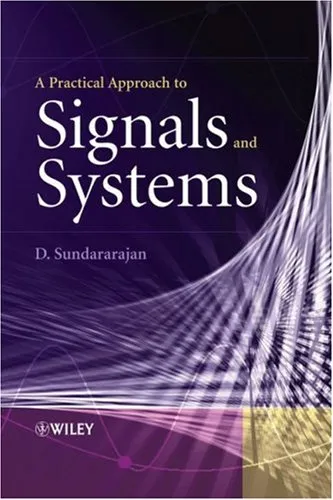
Book guide and evaluation
A practical approach to signals and systems
D. Sundararajan
English
Beginner
Physics
4.7 / 5
0 reviews
2008
Published
400
pages
264
views
Introduction to "A Practical Approach to Signals and Systems" The book "A Practical Approach to Signals and Systems", authored by D. Sundararajan, serves as a comprehensive resource for students, engineers, and practitioners looking to develop a deep understanding of signals a
Before you read
What will you get from this book?
Introduction to "A Practical Approach to Signals and Systems"
The book "A Practical Approach to Signals and Systems", authored by D. Sundararajan, serves as a comprehensive resource for students, engineers, and practitioners looking to develop a deep understanding of signals and systems. With its hands-on approach and emphasis on practical applications, this textbook bridges the gap between complex mathematical theories and real-world signal processing problems. Designed to facilitate learning, it offers clear explanations, worked examples, and numerous exercises, enabling readers to grasp fundamental concepts and tackle advanced topics with confidence.
Detailed Summary of the Book
Signals and systems form the cornerstone of many engineering and scientific disciplines, particularly in fields such as electronics, telecommunications, control systems, and biomedical engineering. Recognizing the importance of these foundational concepts, this book combines theoretical insights with practical applications, making it an indispensable text for both beginners and advanced learners.
The book begins with an overview of signals and their classifications, followed by an introduction to linear time-invariant (LTI) systems. Core topics such as Fourier Series, Fourier Transforms, Laplace Transforms, and Z-Transforms are covered in detail. Unlike traditional texts, the material is presented in a structured and simplified manner, emphasizing intuitive understanding rather than overwhelming mathematical rigor.
One of the defining features of "A Practical Approach to Signals and Systems" is its focus on real-life applications. From communication systems to modern digital signal processing, the concepts discussed in the book find applications in a wide range of industries. It also includes MATLAB-based exercises and examples to provide hands-on experience with computational tools.
The book concludes with advanced topics like discrete-time signal processing and system analysis, ensuring that readers not only develop a solid foundation but also gain the tools necessary to venture into specialized areas of engineering and science.
Key Takeaways
- Comprehensive coverage of fundamental topics such as Fourier Transforms, Laplace Transforms, and Z-Transforms.
- A practical, hands-on approach to learning signals and systems, enriched with real-world applications.
- Emphasis on clarity and understanding, avoiding overly complex mathematical treatments.
- Integration of MATLAB-based exercises to strengthen computational and problem-solving skills.
- A thorough treatment of both continuous-time and discrete-time systems, enabling flexibility for various curricula and learner needs.
Famous Quotes from the Book
"Signals are the language through which the natural world communicates with us; understanding their patterns unlocks the secrets of science and engineering."
"Systems, much like life itself, are dynamic entities. To analyze them is to uncover how change propagates and governs complex phenomena."
"The practical approach makes theory come alive, enabling not just comprehension but also the ability to innovate and solve problems."
Why This Book Matters
The significance of "A Practical Approach to Signals and Systems" lies in its ability to make an otherwise intimidating subject approachable, engaging, and applicable. This book stands out because:
- It caters not only to students but also to industry practitioners, bridging academic learning with industrial relevance.
- The practical methodology fosters a strong conceptual understanding, which is crucial for tackling advanced engineering tasks.
- The integration of MATLAB exercises ensures that readers are equipped with computational skills—vital in today's data-driven world.
- The book's structured and simplified explanations make it accessible to readers with varying levels of expertise.
Whether you're an aspiring engineer, a technical professional, or an academic instructor, this book is a vital addition to your library. It simplifies complex theories, connects them to real-world problems, and empowers readers to harness the power of signals and systems in their careers and research.
Ask this book
Your question is answered in the context of this title and author. Each answer uses 2 points.
Sign in to ask the book assistant.
Reader reviews
0 reviews, 4.7 average out of 5
No reviews yet
If you have read this book, help the next reader with your experience.
Write a review
Sign in to publish a review.
Reader questions and answers
Ask a focused question and learn from the community.
Sign in to ask or answer a question.
No questions yet
Be the first to ask a clear, useful question.
What to read next
Related references that continue this learning path.


Modern Computer Vision with PyTorch: A Practical Roadmap From Deep Learning Fundamentals to Advanced Applications and Generative AI, 2nd Edition
V Kishore Ayyadevara,Yeshwanth Reddy
2023
View book