Book guide and evaluation
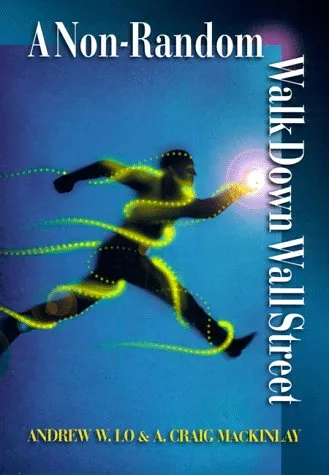
A Non-Random Walk Down Wall Street
Andrew W. Lo,A. Craig MacKinlay
English
Beginner
Financial Planning
4.5 / 5
0 reviews
1999
Published
436
pages
546
views
Introduction to 'A Non-Random Walk Down Wall Street' 'A Non-Random Walk Down Wall Street' is a seminal work authored by Andrew W. Lo and A. Craig MacKinlay, which challenges the traditional view of efficient markets and the random walk hypothesis. This book is a qu
Before you read
What will you get from this book?
Introduction to 'A Non-Random Walk Down Wall Street'
'A Non-Random Walk Down Wall Street' is a seminal work authored by Andrew W. Lo and A. Craig MacKinlay, which challenges the traditional view of efficient markets and the random walk hypothesis. This book is a quintessential read for anyone keen on understanding market dynamics beyond conventional financial theories. By meticulously dissecting the assumptions underlying the Efficient Market Hypothesis (EMH), the authors offer profound insights into the complexities of financial markets through empirical evidence and statistical analysis.
Detailed Summary of the Book
The book delves deep into the fabric of financial markets, carefully analyzing the notion that security prices move randomly, a cornerstone of the Efficient Market Hypothesis. Through rigorous research and comprehensive data analysis, Andrew W. Lo and A. Craig MacKinlay demonstrate that markets do not always behave randomly. By exploring anomalies and patterns that could suggest predictability, the authors argue for the existence of inefficiencies in markets that can be exploited.
The text discusses several methodologies employed in the analysis of financial data, including statistical techniques and mathematical models, to identify these patterns. These methodologies challenge the random walk theory, suggesting that past stock prices, trading volumes, and other financial indicators can provide valuable information about future market behavior. The authors bring together various studies documenting the predictability of stock returns, emphasizing that the random walk theory is not as robust as traditionally believed.
Key Takeaways
- Financial markets exhibit patterns and anomalies that can be systematically analyzed and understood.
- The Efficient Market Hypothesis is challenged through empirical evidence showing predictability in stock returns.
- Statistical and mathematical tools are crucial for uncovering significant insights into market behavior.
- Understanding market inefficiencies can lead to more effective investment strategies.
Famous Quotes from the Book
"If stock prices are governed by a random walk, then attempts to predict their future movements are useless."
"Empirical evidence strongly suggests that markets exhibit momentum effects which violate the efficient markets paradigm."
Why This Book Matters
'A Non-Random Walk Down Wall Street' matters because it offers a paradigm shift in understanding market behavior, breaking away from traditional theories. For academics, professionals, and investors, this book provides invaluable perspectives on market predictability and efficiency. It arms readers with knowledge that challenges the status quo, encouraging a rethink of investment strategies grounded solely on the random walk hypothesis. By unraveling the complexities of market dynamics, this book not only questions existing financial doctrines but also lays the groundwork for future exploration and innovation in financial analysis and investment strategy.
Ask this book
Your question is answered in the context of this title and author. Each answer uses 2 points.
Sign in to ask the book assistant.
Reader reviews
0 reviews, 4.5 average out of 5
No reviews yet
If you have read this book, help the next reader with your experience.
Write a review
Sign in to publish a review.
Reader questions and answers
Ask a focused question and learn from the community.
Sign in to ask or answer a question.
No questions yet
Be the first to ask a clear, useful question.
What to read next
Related references that continue this learning path.
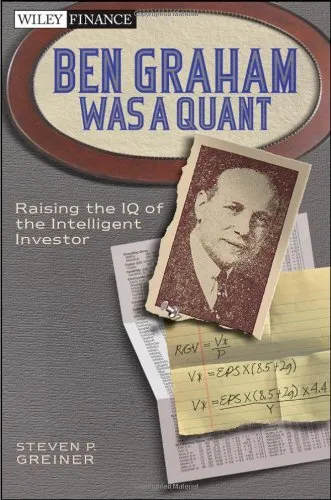
Ben Graham Was a Quant: Raising the IQ of the Intelligent Investor (Wiley Finance)
Steven P. Greiner
2011
View book