

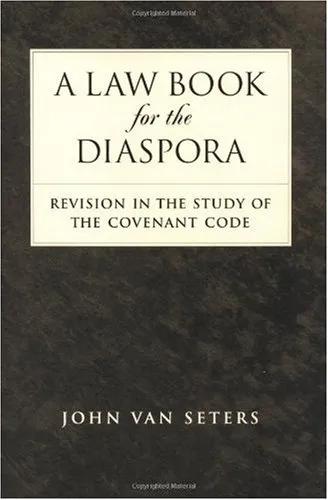
Book guide and evaluation
A Law Book for the Diaspora: Revision in the Study of the Covenant Code
John Van Seters
English
Beginner
Art
4.7 / 5
0 reviews
2002
Published
249
pages
117
views
Introduction to 'A Law Book for the Diaspora: Revision in the Study of the Covenant Code' Written by John Van Seters, 'A Law Book for the Diaspora' presents a profound reexamination of the Covenant Code within the Torah, challenging long-held assumptions about its origin
Before you read
What will you get from this book?
Introduction to 'A Law Book for the Diaspora: Revision in the Study of the Covenant Code'
Written by John Van Seters, 'A Law Book for the Diaspora' presents a profound reexamination of the Covenant Code within the Torah, challenging long-held assumptions about its origins, development, and purpose. This book is both a critical assessment of traditional scholarship and a bold proposal for perceiving the text as a product of Jewish life in the Diaspora.
The Covenant Code, located in Exodus 20:22–23:33, has historically been understood as a fundamental legal corpus within biblical literature. Scholars have often placed its composition in the early Israelite monarchy, viewing it as reflective of the social and religious landscapes of ancient Israel. However, Van Seters offers a revolutionary thesis: this legal code was not a relic of pre-monarchic times but instead reflects the intellectual and theological concerns of Jewish communities living in the Babylonian or Persian Diaspora. By re-contextualizing the Covenant Code, this book opens fresh dialogues about how ancient texts were shaped by, and adapted to, broader socio-political realities.
A Detailed Summary of the Book
Laying the groundwork for his arguments, Van Seters thoroughly critiques the Documentary Hypothesis, which traditionally views the Covenant Code as pre-dating the Deuteronomic and Priestly texts. He reconsiders the relationship between these corpora and argues that the compositions of the Covenant Code were likely written in response to the concerns of Jewish Diaspora communities during the Babylonian Exile or later under Persian rule.
Van Seters pinpoints elements of legal and ethical revisionism within the Covenant Code, suggesting that its authors adapted earlier traditions to address the challenges of maintaining Jewish identity and cohesion in a foreign environment. The book delves into the literary and compositional strategies of the Covenant Code, emphasizing its connections to the wider cultural and legal influences of the Ancient Near East, Egyptian law, and Mesopotamian traditions.
Further, Van Seters explores how the Covenant Code aligns with the needs of a displaced community seeking to preserve its distinctiveness while engaging in cross-cultural discourse. He examines issues like slavery, social justice, religious impurity, and agricultural laws, demonstrating that these texts serve not as a historical reflection of early Israel but as a vision for Jewish survival and renewal during and after the exile. The implications of this thesis are far-reaching, reshaping our understanding of biblical law and the historical context in which it was formulated.
Key Takeaways from the Book
- The Covenant Code should be read as a product of the Jewish Diaspora, not as an artifact of the monarchic period of ancient Israel.
- The adaptation and revision of biblical laws reflect the dynamic interaction between Israel’s legal traditions and foreign cultural contexts.
- Van Seters challenges the dominant Documentary Hypothesis, arguing for a more unified and historically specific understanding of biblical legal texts.
- Biblical law is presented as a theological response to the challenges of maintaining identity in exile, emphasizing inclusivity and adaptation while upholding tradition.
Famous Quotes from the Book
"The Covenant Code is not a fossilized remnant of an ancient culture, but a living document, reinterpreted and reshaped to address the existential crises of the Diaspora."
"An exilic or post-exilic context does not undermine the authority of the Covenant Code but situates it squarely within the enduring struggle for preservation and adaptation in the face of imperial domination."
"The law becomes a way not only of resisting assimilation but also of engaging creatively with the dominant cultural and legal norms of surrounding societies."
Why This Book Matters
This book redefines how scholars and readers approach the biblical legal texts, providing a compelling argument for their relevance and adaptability. By repositioning the Covenant Code as a product of the Diaspora, Van Seters encourages us to see the Bible not merely as literature of ancient kingdoms, but as a dynamic, evolving collection shaped by historical upheavals and cultural exchanges.
For anyone interested in the intersection of history, religion, and literature, 'A Law Book for the Diaspora' is essential reading. It challenges us to rethink how we interpret sacred texts and stresses the importance of understanding the socio-political contexts that shape them. This book does not merely revise our view of the Covenant Code but invites us to embrace new frameworks for understanding tradition, adaptation, and identity in the biblical world.
Through rigorous scholarship and innovative thinking, Van Seters' work offers a lens for appreciating how ancient Jewish communities navigated their tumultuous realities and preserved their heritage. It is a vital contribution to biblical studies, legal history, and the enduring dialogue between scripture and society.
Ask this book
Your question is answered in the context of this title and author. Each answer uses 2 points.
Sign in to ask the book assistant.
Reader reviews
0 reviews, 4.7 average out of 5
No reviews yet
If you have read this book, help the next reader with your experience.
Write a review
Sign in to publish a review.
Reader questions and answers
Ask a focused question and learn from the community.
Sign in to ask or answer a question.
No questions yet
Be the first to ask a clear, useful question.
What to read next
Related references that continue this learning path.



Modern Computer Vision with PyTorch: A Practical Roadmap From Deep Learning Fundamentals to Advanced Applications and Generative AI, 2nd Edition
V Kishore Ayyadevara,Yeshwanth Reddy
2023
View book