
Six Easy Pieces: Essentials of Physics Explained by Its Most Brilliant Teacher
Richard P. Feynman,Robert B. Leighton,Matthew Sands
2011
View book
Book guide and evaluation
Richard D. Mattuck
0 reviews
Published
pages
views
Introduction Welcome to A Guide to Feynman Diagrams in the Many-Body Problem, a definitive resource for understanding and applying Feynman diagrams in the realm of quantum many-body physics. Authored by Richard D. Mattuck, this book offers both students and professionals a
Before you read
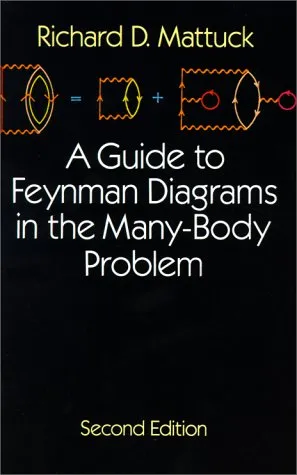
Welcome to A Guide to Feynman Diagrams in the Many-Body Problem, a definitive resource for understanding and applying Feynman diagrams in the realm of quantum many-body physics. Authored by Richard D. Mattuck, this book offers both students and professionals a lucid and comprehensive approach to unlocking the power of Feynman diagrams. Through a balanced blend of theory, practical examples, and intuitive explanations, this guide aims to illuminate the path through one of the most powerful tools in modern physics.
Feynman diagrams are an elegant visual representation of mathematical expressions that describe interactions of particles in quantum field theory and many-body systems. The book meticulously details how these diagrams can simplify complex calculations and foster deeper insights into the behavior of interacting quantum systems. Whether you are a physicist, chemist, or condensed matter researcher, this book equips you with essential knowledge for tackling advanced problems using Feynman diagram techniques.
The book begins with an accessible introduction to the fundamentals of many-body physics and the role Feynman diagrams play in understanding such systems.
The early chapters establish a strong foundation by explaining concepts such as second quantization, Green's functions, and perturbation theory. These topics, often intimidating for newcomers, are presented with clarity and simplicity that demystifies their complexity. Gradually, the reader is guided through the process of constructing and interpreting Feynman diagrams, with a clear focus on applications to real-world physical systems.
As the chapters progress, topics such as electron-electron interactions, phonons in solids, and the behavior of superfluid helium are tackled. The book also dedicates significant attention to the mathematical underpinnings of diagrammatic techniques, offering detailed derivations for advanced concepts like self-energy and propagators. These derivations enable the reader to bridge the gap between abstract theory and practical problem solving.
By the conclusion of the text, readers are equipped not only with a deeper understanding of quantum many-body problems but with the tools needed to apply Feynman diagrams confidently in their own research.
"Feynman diagrams do not just simplify calculations; they reveal a deeper understanding of the interactions at play."
"To those venturing into the many-body problem, the art of constructing Feynman diagrams is a gateway to clarity, ingenuity, and profound intellectual satisfaction."
"In the many-body system, the complexity of the equations is not a wall, but rather a landscape best navigated with the right tools."
In the rapidly advancing field of quantum many-body theory, having a strong grasp of Feynman diagrams is indispensable. This book matters because it addresses a critical necessity: the need to simplify and demystify complex calculations for quantum systems without losing the essence of their physical significance.
Unlike many other texts, A Guide to Feynman Diagrams in the Many-Body Problem strikes a perfect balance between theoretical rigor and practical applicability. It speaks to physicists and researchers who are looking to build a strong foundation while exploring new areas of application. Whether tackling problems in condensed matter physics, quantum fluids, or beyond, the insights and methods presented in this book remain relevant, powerful, and indispensable.
Furthermore, the book's readability and structured learning path make it an ideal choice for both students and professionals. The clear examples inspire confidence in handling complex integrals, while the step-by-step guidance ensures no reader is left behind. Its timeless contributions to the understanding of many-body systems have cemented its place as a classic in physics education and research.
Your question is answered in the context of this title and author. Each answer uses 2 points.
0 reviews, 4.5 average out of 5
Sign in to publish a review.
Ask a focused question and learn from the community.
Related references that continue this learning path.
Richard P. Feynman,Robert B. Leighton,Matthew Sands